
 Calculus has two main operations, differentiation and integration, but understanding them requires us to build upon several other mathematical concepts.
Contents
Real and Imaginary Numbers
Real Numbers
Real numbers (ℝ) are any value that can be found on a continuous number line. This includes both positive and negative numbers, zero, fractions, decimals, and values that never end or repeat.
Imaginary Numbers
An imaginary number (ℂ) is a number that equals a real number multiplied by the imaginary unit i, which is defined by the property i2 = -1 or i = √-1.

References
Real Numbers
“3.1: Introduction to the Real Number System.” LibreTexts, June 30, 2024. https://math.libretexts.org/Courses/Coalinga_College/Math_for_Educators_(MATH_010A_and_010B_CID120)/03%3A_The_Real_Number_System/3.01%3A_Introduction_to_the_Real_Number_System.
Khandelwal, Neha. “Real Numbers.” CK-12 Foundation, September 11, 2026. https://flexbooks.ck12.org/cbook/ck-12-cbse-math-class-10/section/1.1/primary/lesson/real_numbers/.
Σ “Real Numbers.” Mathematical Mysteries. January 17, 2022. https://mathematicalmysteries.org/real-numbers-2/.
Imaginary Numbers
“A Visual, Intuitive Guide to Imaginary Numbers.” BetterExplained. Accessed October 24, 2026. https://betterexplained.com/articles/a-visual-intuitive-guide-to-imaginary-numbers/.
“Imaginary (Non-Real) and Complex Numbers.” mathhints.com, November 20, 2012. https://mathhints.com/intermediate-algebra/complex-numbers/.
“Imaginary Numbers – Calculating.” CUEMATH. Accessed October 24, 2026. https://www.cuemath.com/numbers/imaginary-numbers/.
Σ “Imaginary Numbers.” Mathematical Mysteries. January 11, 2024. https://mathematicalmysteries.org/imaginary-numbers/.
Functions
A function is any set of ordered pairs (x, y) that connects elements from a first set (domain) to a second set (range). A single input (x) can link to one, zero, or multiple outputs (y).

Identification of a Function in Math – CUEMATH
References
“What Are Functions in Math?” CUEMATH. Accessed October 24, 2026. https://www.cuemath.com/calculus/What-are-functions/.
“What Is a Function?” BYJU’S, September 18, 2019. https://byjus.com/maths/what-is-a-function/.
“1.1: Functions and Function Notation.” LibreTexts, October 27, 2015. https://math.libretexts.org/Bookshelves/Precalculus/Precalculus_1e_(OpenStax)/01%3A_Functions/1.01%3A_Functions_and_Function_Notation.
Σ “Functions I.” Mathematical Mysteries. November 22, 2022. https://mathematicalmysteries.org/functions-i/.
Variables and Constants
A variable is a letter that stands for a number whose value can change or is not yet known. Common choices are , , , and , but any letter works.
A constant is a fixed number whose value does not change. In 5x2 + 3x− 8, the constant is −8. It carries its sign, so the constant is −8, not 8.

References
“Difference Between Constant and Variables.” BYJU’S, August 7, 2018. https://byjus.com/maths/difference-between-constants-and-variables/.
“Variables Constants and Expressions: A Beginner Guide.” Bhanzu, September 10, 2026. https://bhanzu.com/math/algebra/variables-constants-and-expressions.
“Variables and Constants in Algebraic Expressions.” BYJU’S, August 13, 2016. https://byjus.com/maths/variables-and-constants-in-algebraic-expressions/.
Domain and Range
The domain of a function is all possible values of x that can be used as input to the function, which will result in a real number as the output.
The range of a function is the set of all possible output values of a function.

References
“Domain and Range of a Function: Rules & Examples.” Bhanzu, September 22, 2026. https://bhanzu.com/math/calculus/domain-and-range-of-a-function.
Dominguez, Victoria Cristian Martinez, and Sanaa Saykali. 4.7: Domain and Range of a Function. 2020. https://math.libretexts.org/Bookshelves/Applied_Mathematics/Calculus_for_Business_and_Social_Sciences_Corequisite_Workbook_(Dominguez_Martinez_and_Saykali)/04%3A_Functions/4.07%3A_Domain_and_Range_of_a_Function.
“How to Find Domain and Range: A Step-by-Step Guide.” Mathnasium, June 15, 2026. https://www.mathnasium.com/math-centers/steinerranch/news/find-domain-range.
Graphs of Functions
Graphs bring equations to life. They are one of the easiest and most effective ways to visualize mathematics. A graph is a visual representation of a mathematical relationship. Instead of looking at an equation and trying to understand it entirely through symbols, we can plot its input and output values on coordinate axes.
Graphing a function means plotting values on a coordinate plane to show the relationship between input and output. Graphs of functions turn abstract algebra into a clear, visual picture. By plotting input-output pairs (x, f(x)) on the Cartesian coordinate plane, you can spot patterns, trends, and key features that numbers alone hide.

References
“Graphing Function.” GeeksforGeeks, April 24, 2024. https://www.geeksforgeeks.org/maths/graphing-function/.
“Identify Functions Using Graphs.” Module 5: Function Basics. lumen. Accessed October 26, 2026. https://courses.lumenlearning.com/waymakercollegealgebra/chapter/identify-functions-using-graphs/.
Pierson, David. “Graphing of Functions.” EBSCO, 2022. https://www.ebsco.com/research-starters/communication-and-mass-media/graphing-functions/.
Limits
The limit of any function is defined as the value that the function approaches when the independent variable of the function approaches a particular value. A function’s limit exists only when the left-hand limit and right-hand limit of the function both exist and are equal.

References
“An Intuitive Introduction to Limits.” BetterExplained. Accessed October 25, 2026. https://betterexplained.com/articles/an-intuitive-introduction-to-limits/.
Dawkins, Paul. “Calculus I.” Section 2.10 : The Definition of the Limit. Paul’s Notes, July 31, 2026. https://tutorial.math.lamar.edu/classes/calci/defnoflimit.aspx.
“Limits.” BYJU’S, January 31, 2018. https://byjus.com/maths/limits/.
Σ “Limits.” Mathematical Mysteries, December 21, 2021. https://mathematicalmysteries.org/limits/.
Continuity
Continuity is a property of a function. When you talk about continuity, you describe whether the graph of a function exists for all values of x in an interval, and that these points are adjacent to each other, meaning there are no gaps between any of them.
When a graph is continuous, it means that you can draw it without lifting your pencil. By contrast, there are graphs where the y-value of a given x-value is some distance away from the y-value of an adjacent x-value. These graphs are not continuous. Functions that are not defined for all x-values on an interval are also not continuous on that interval.

References
Dawkins, Paul. “Calculus I.” Continuity. Paul’s Notes, July 31, 2026. https://tutorial.math.lamar.edu/classes/calci/continuity.aspx.
Strang, Gilbert, and Edwin “Jed” Herman. “2.4 Continuity.” In Calculus Volume 1. OpenStax, 2016. https://openstax.org/books/calculus-volume-1/pages/2-4-continuity.
“Continuity and Discontinuity.” BYJU’S, November 6, 2019. https://byjus.com/maths/continuity-and-discontinuity/.
“Mastering Continuity in Calculus: Key Concepts & Applications.” StudyPug. Accessed October 24, 2026. https://www.studypug.com/calculus-help/continuity/?view=read.
Σ “Continuous Functions & Continuity.” Mathematical Mysteries. July 7, 2023. https://mathematicalmysteries.org/continuous-functions-continuity/.
B, Roger. “Limits and Continuity – AP Calc AB Study Guide.” Save My Exams, May 1, 2026. https://www.savemyexams.com/ap/maths/college-board/calculus-ab/20/revision-notes/limits-and-continuity/continuity/continuity/.
Differentiability
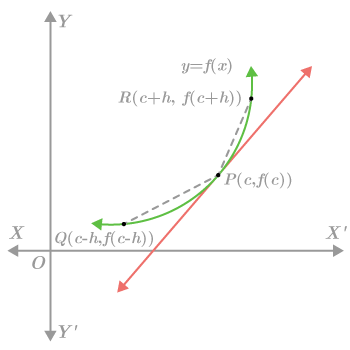
For a function to be differentiable, its derivative must exist at every point in its domain, meaning the function is “smooth” and has no sharp corners, breaks, or vertical tangents. Graphically, if you zoom in closely enough on a differentiable function, it will appear as a single, perfectly straight line.
References
Σ “Differentiable.” Mathematical Mysteries, June 30, 2026. https://mathematicalmysteries.org/differentiable/.
“Differentiability of a Function: Definition & Rules.” Bhanzu, September 22, 2026. https://bhanzu.com/math/calculus/differentiability-of-a-function.
Khandelwal, Neha. “Differentiability at a Point.” CK-12 Foundation, October 15, 2026. https://flexbooks.ck12.org/cbook/ck-12-cbse-maths-class-12/section/5.3/primary/lesson/differentiability-at-a-point/.
McLean, Rachel. “Differentiable Function: Meaning, Formulas and Examples.” Outlier, March 10, 2022. https://articles.outlier.org/what-does-differentiable-mean.
Derivatives
TBS
References
TBD
Increasing and Decreasing Functions
A function is increasing when its graph goes up from left to right, and decreasing when its graph goes down from left to right.
- Increasing Function: As x1 < x2, the output values satisfy f(x1) \le f(x2).
- Strictly Increasing Function: As x1 < x2, the output values satisfy f(x1) < f(x2) (no flat sections).
- Decreasing Function: As x1 < x2, the output values satisfy f(x1) \ge f(x2).
- Strictly Decreasing Function: As x1 < x2, the output values satisfy f(x1) > f(x2) (no flat sections).

References
Σ “Functions I.” Increasing, Decreasing and Constant Functions. Mathematical Mysteries, November 22, 2022. https://mathematicalmysteries.org/functions-i/#increasing-decreasing-and-constant-functions.
“Increasing and Decreasing Functions.” CUEMATH. Accessed October 29, 2026. https://www.cuemath.com/calculus/increasing-and-decreasing-functions/.
Pierce, Rod. “Increasing and Decreasing Functions.” Math Is Fun, n.d. Accessed October 29, 2026. https://www.mathsisfun.com/sets/functions-increasing.html.
Monotonic Functions
A monotonic function is a function that preserves or reverses a given order, meaning it consistently moves in one direction—either entirely non-decreasing or entirely non-increasing—across a specified domain.
Monotonic functions move in one direction across an interval: they are either entirely non-decreasing or entirely non-increasing, never both. You test monotonicity with the first derivative, where f′(x)>0 means increasing, f′(x)<0 means decreasing, and f′(x)=0 marks a stationary candidate. A strictly monotonic function is one-to-one, which is exactly what makes it invertible.
Key Properties
- Invertibility: Strictly monotonic functions are one-to-one (injective), which guarantees they have an inverse function.
- Discontinuities: Monotonic functions cannot have oscillatory or essential discontinuities; any discontinuities they have are strictly jump or removable.

References
Kench, Riley. “Monotonic Function.” study.com. Accessed October 29, 2026. https://study.com/learn/lesson/video/monotonically-increasing-function-example.html.
“Monotonic Functions: Increasing and Decreasing.” bhanzu, September 23, 2026. https://bhanzu.com/math/calculus/monotonic-functions.
“Monotonic Function — Definition, Formula & Examples.” Mathwords. Accessed October 29, 2026. https://www.mathwords.com/m/monotonic_function.htm.
Slope and Tangent Lines
The slope of a line is the measure of the steepness and the direction of the line. Finding the slope of lines in a coordinate plane can help in predicting whether the lines are parallel, perpendicular, or none.
A tangent line is a line that gives the local direction of a curve at a particular point, when the appropriate derivative exists. The slope of this tangent line is given by the derivative at that point.
References
TBD
Critical Points
A point c in the domain of a function f(x) is called a critical point of f(x), if f ‘(c) = 0 or f ‘(c) does not exist.

References
“Critical Points Solved Examples.” BYJU’S, February 13, 2020. https://byjus.com/jee/critical-points-solved-examples/.
Dawkins, Paul. “Calculus I.” Critical Points. Paul’s Notes, July 31, 2026. https://tutorial.math.lamar.edu/classes/calci/criticalpoints.aspx.
Local Maxima and Local Minima
Local Maximum
A local maximum is a point where a function has a value at least as large as the values at nearby points.
A local maximum if f(x0) > f(x) for all x near x0.
Local Minimum
A local minimum is a point where its value is at most as large as the values at nearby points.
A local minimum if f(x0) < f(x) for all x near x0.

References
“Local Maximum and Minimum, Finding the Local Maximum and Minimum.” CUEMATH. Accessed October 23, 2026. https://www.cuemath.com/calculus/local-maximum-and-minimum/.
Global Maxima and Global Minima
A global maximum is where the function value is higher than at any other point in the domain.
A global minimum is where the function value is the lowest among all points in the domain.

References
“How to Find Global Maxima and Minima.” GeeksforGeeks, April 29, 2024. https://www.geeksforgeeks.org/maths/how-to-find-global-maxima-and-minima/.
Concave and Convex Functions
Concavity and convexity describe how a graph bends.
Convex Functions
A convex function has a graph that bends upwards, like a bowl. More formally, the line segment joining two points on its graph lies on or above the graph.

Concave Functions
A concave function bends downwards, like an upside-down bowl. The line segment joining two points on its graph lies on or below the graph.

References
“Convex and Concave Functions.” GeeksforGeeks, September 22, 2024. https://www.geeksforgeeks.org/engineering-mathematics/convex-and-concave-functions/.
Second Derivatives
TBS
References
TBD
Inflection Points
Inflection Point describes a point where the curvature of a curve changes direction. It represents the transition from a concave to a convex shape or vice versa.

References
“Inflection Point.” GeeksforGeeks, May 27, 2021. https://www.geeksforgeeks.org/maths/inflection-point/.
Saddle Points
The saddle point in the context of a function of the two or more variables is a point on the graph where the function does not exhibit a local maximum or minimum but instead the slope changes direction.

References
TBD
Asymptotes
Vertical Asymptote
A vertical asymptote is a vertical line that a function approaches but never reaches as the input value gets close to a certain number. In other words, if the values of a function increase or decrease without bound ( +∞ or −∞ ) as x approaches a particular value ak, then the line x = k is a vertical asymptote.

Horizontal Asymptote
Horizontal asymptotes are horizontal lines (parallel to the x-axis) that a graph approaches as x→+∞ or x→−∞, but typically never actually reaches.
- It describes the end behavior of a function, what happens to the function as the input becomes very large (positive or negative).
- This concept helps in analyzing the long-term behavior of the functions and is essential in various fields such as physics, engineering, and economics.

References
“Horizontal Asymptote.” GeeksforGeeks, September 3, 2024. https://www.geeksforgeeks.org/maths/horizontal-asymptote/.
“Vertical Asymptote.” GeeksforGeeks, August 27, 2024. https://www.geeksforgeeks.org/maths/vertical-asymptote/.
Convergence and Divergence
TBS
References
TBD
Infinite Series
TBS
References
TBD
References
Soni, Ekta. “22 Calculus Terms You Must Know Before You Start Learning Calculus.” Women in Technology, October 21, 2026. https://medium.com/womenintechnology/before-you-learn-calculus-make-sure-you-understand-these-22-terms-a19bdc97e974.
[ ℰ ] This exceptional reference is highly recommended for your consideration.
The featured image on this page is from the GeeksForGeeks website.