Don’t know much trigonometry
Don’t know much about algebra
Don’t know what a slide rule is for
Wonderful World – Sam Cooke
Why should you read this article? You shouldn’t unless you want to become a lifelong learner. If you are a lifelong learner, you are to be commended. If you are not, then you should be commended for staying in school, finishing school, and you should read this article.
Why did I write this article? Many students in the public school system where I substitute teach struggle with different classes; some do not care about the grades they receive, and some have given up on learning. Many ask how what they are taught will benefit them or when they will ever use what they are being taught. In life, class is never dismissed.
To all students in school or those who graduated, I pass on this wisdom: “What you’re learning now might feel like puzzle pieces that don’t yet fit, but each lesson is shaping how you think, solve problems, and understand the world. You may not use every formula or fact directly, but you’re building a mind that can tackle challenges, connect ideas, and create opportunities in ways you can’t yet imagine. The real value lies in becoming someone who can learn anything, adapt anywhere, and contribute everywhere.“
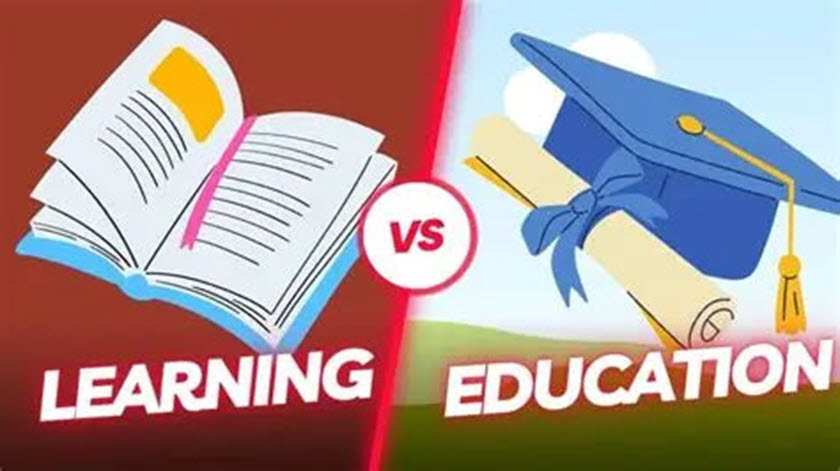
The goal for each person is to achieve the ability to learn anything, adapt anywhere, and contribute everywhere. Many people are educated, but they are not necessarily learners. They have acquired knowledge, skills, and values through structured instruction in educational institutions[†], but they do not know how to learn.
For example, the Academic Bowl: Study Guide has this question: “Defying the White House, Speaker of the House John Boehner invited this Israeli Prime Minister to address a joint meeting of the U.S. Congress in March 2015.” The answer: Benjamin Netanyahu. That is education—a fact that is memorized. Learning involves asking questions such as: Why did the White House not want the Israeli Prime Minister to visit the U.S. Congress? Why did Speaker of the House John Boehner want the Israeli Prime Minister to visit the U.S. Congress? What did the Israeli Prime Minister say to the U.S. Congress? When the Israeli Prime Minister addressed the joint meeting of the U.S. Congress in March 2015, what was the historical significance of his address? [#] That is learning! Education is memorizing dates, facts, figures, equations, people, places and things.
Learn Anything
In his book, Beyond Brilliance: The Blueprint for Learning Anything, Lucas Miller states: “In school, we are taught what to learn. Vocabulary, the Pythagorean theorem, Roman history, the periodic table. The list goes on and on. But not once are we taught how to learn. How to pick up concepts quickly. How to effectively study. How to not waste our time.”
You might believe that you were born with a certain level of intelligence and that’s all. You’re either smart or you’re not. You have a fixed mindset. What you should adopt is a growth mindset, which is the belief that abilities and intelligence can be improved through dedication and effort. People with a growth mindset welcome challenges, view setbacks as learning opportunities, and persist despite obstacles.
Does what I just wrote suggest we should discard the current public education system and build a better one? No. What I’ve learned over the years is that each person must take responsibility for what they learn and become a proactive learner within any educational setting, whether it’s K-12 (with the help of their parents), undergraduate, or postgraduate level. Go beyond what is taught in the classroom and truly learn. But how do you learn?
First, I recommend that you read, meditate on, and apply the ideas presented in the book Beyond Brilliance: The Blueprint for Learning Anything. Miller’s book shares many lessons I have learned the hard way over the years, helping me become a lifelong learner. While they require some effort, these strategies are straightforward to put into practice. They are suitable for all students in or out of school.
Second, be curious and ask questions.
“The man who asks a question is a fool for a minute,
the man who does not ask is a fool for life.” – Confucius
What questions? Follow the advice of Rudyard Kipling.
“I keep six honest serving-men
(They taught me all I knew);
Their names are What and Why and When
And How and Where and Who.”
– Rudyard Kipling
Can the use of who, what, when, where, why and how be used in any class? I say yes. Here are some examples.
Mathematics
What You Learned in School: The slope of a line is a number that describes the steepness and direction of the line. It’s calculated as the “rise over run”, or the change in the y-value divided by the change in the x-value between any two points on the line.
Questions You Could Ask: Why do I need to know this? Where will I use it?
Answers: Slope also describes ratios, proportional relationships, and the rate of change (e.g., velocity). You use it in fields such as finance, physics, economics, and construction (e.g., ramps and roofs).
Music
What You Learned in School: The Baroque period was a European artistic and architectural style prevalent from the late 16th to the mid-18th centuries. Grand, ornate designs and a sense of drama and emotional intensity characterized the Baroque period.
Questions You Could Ask: What are the main characteristics of Baroque art, music, and architecture? How does Baroque art differ from the Renaissance? How did the Baroque style spread across Europe? What were the major social and political contexts of the Baroque period?
Answers: Baroque art contrasts with the Renaissance emphasis on balance and proportion, characterized by dynamic compositions, intense colors, and a dramatic use of light and shadow. The style spread across Europe through various channels, including the Catholic Church’s Counter-Reformation efforts and the patronage of powerful monarchs. The Baroque period was marked by social and political contexts including the Catholic Counter-Reformation, the rise of absolute monarchies, and significant scientific and philosophical advancements.
Social Studies
What You Learned in School: The Silk Road refers to a historical network of trade routes that connected the East and West, facilitating the exchange of goods, ideas, and cultures between China and the Mediterranean world.
Questions You Could Ask: Why is it called the “Silk Road?” What were the different routes and regions involved, and how did they change over time?
Answers: The Silk Road is named for the lucrative silk trade that flowed from China to the West along these routes. Key regions included China, Central Asia, Persia, and the Mediterranean world. Over time, the routes shifted due to political changes, the rise and fall of empires, and the development of new technologies like maritime trade.
When you ask questions, you increase your knowledge and hopefully connect what you’re learning with what you already know. You are “connecting the dots,” meaning you understand how seemingly unrelated pieces of information relate to each other to create a larger, clearer picture or understanding. By gathering clues, facts, or ideas, you can gain a comprehensive understanding of the situation or solve a problem. A learner asks questions.
From The Futuristic Minds: “The difference between education and learning is not just an exercise in semantics; it is a profound insight that can reshape our approach to personal and professional growth. By understanding these differences, we empower ourselves to become lifelong learners, adaptable thinkers, and innovative contributors to a rapidly evolving world.”
How Does This Relate to Mathematics?
When I was young, I wanted to be a mathematician without knowing what mathematics was all about. I just enjoyed mathematics and learning about mathematics. In high school I was excited about going to college and advancing my knowledge of mathematics.
What I learned in college was to not rely on the professor or the selected textbook, but to consult additional sources. (This was way before the Internet, so I could only go to the library and read other mathematics books.) I started to make learning my own.
After graduation from college, I discovered that I did not know how to apply what I learned. I WAS EDUCATED! Here again, I had to refresh my memory and do research on how to use what I had learned. (Again, before the Internet.) I learned many of the lessons that Miller outlines in Beyond Brilliance: The Blueprint for Learning Anything to learn mathematics. The things I learn are outlined in my website Mathematical Mysteries. As a substitute teacher at a middle school I apply all that I have learned and try to pass that onto the students, especially in math classes.
“The purpose of a mathematics lesson should not be the logical derivation of some incomprehensible statements from other equally incomprehensible ones. It is necessary to explain to the audience what the discussion is about and to teach them to use, not only the results presented, but the methods and ideas”. – Vladimir Igorevich Arnold
Learning how to learn is
the most valuable skill of all!
Ad astra per aspera.
References
Lucas Miller, Beyond Brilliance: The Blueprint for Learning Anything (Lexington, KY: CreateSpace Independent Publishing Platform, 2016).
Most books for students give you the same old advice: work hard, take detailed notes, use a planner, yadda yadda. If you’re looking for a book like that, ignore this one. Beyond Brilliance shows you a better, faster, and easier way to succeed in school and develop mastery (according to decades of science). Read it and you’ll know why certain memories are stickier than others, why self-control is more important than effort, and why snoozing more can mean studying less. The truth is, getting top grades and becoming an effective learner is something anyone can do. You don’t need to be naturally “brilliant”—intelligence is something we can all develop over time. You don’t need to pull all-nighters. You don’t need to sacrifice your social life. You don’t even need to give up the gym. What you really need to do is learn how learning actually works. Then, you can use that skill to get better at anything you like. This book shows you the way. You’ll learn why certain myths about learning might be holding you back, the most practical and most efficient tools researchers know about how to absorb material, how to conquer procrastination, and tons more straightforward insights that will inspire and empower you. Unlike vague, scammy self-help books, Beyond Brilliance is helpful. And unlike academic textbooks, it’s understandable and to the point. With its short, illustrated chapters and focus on general principles, it’s the perfect playbook for any student who’s ever dreamed of a better way. Engineering majors at MIT, C students, victims of tracking and standardized testing, homeschoolers, and graduate students in a variety of fields will all find valuable guidance in these pages.
“Education vs. Learning – What’s the Difference?” 2025. This vs. That. Accessed July 4. https://thisvsthat.io/education-vs-learning.
Education and learning are distinct yet interconnected concepts. Education provides a structured pathway for acquiring knowledge and skills, while learning encompasses a broader range of experiences and self-directed exploration. Both education and learning play vital roles in personal and professional growth, with education offering a formal foundation and learning fostering adaptability, creativity, and lifelong curiosity. By embracing the synergy between education and learning, individuals can unlock their full potential and navigate the complexities of the modern world.
Loveless, Becton, Annemiek, Mm Far, Keshav, A. Brennick, Aliyu Ishaq Namadi, Baya, et al. 2023. “15 Learning Theories in Education (A Complete Summary).” Education Corner. April 14. https://www.educationcorner.com/learning-theories-in-education/.
If you are just starting out on your journey as a teacher and you are worried that you’ll do it wrong, just remember these basic principles:
1. Building positive relationships with students is the bedrock of EVERYTHING.
2. Setting clear boundaries that students are aware of.
3. Consequences of breaking those boundaries are also known in advance.
4. Focus on and reward the positive things that happen in your classroom (positive reinforcement).1.
5. Treat your students as people with thoughts and feelings of their own that, while may seem irrelevant to you, they are not to them.
6. It is easier and more effective to change your perspective to theirs than make them change to yours.
Remember, their world is not the one you grew up in.
S, Prabhat. 2011. “Difference Between Education and Learning.” Difference Between. July 28. https://www.differencebetween.net/miscellaneous/difference-between-education-and-learning/.
1. Education is the process of imparting knowledge, values, skills and attitudes, which can be beneficial to an individual. On the contrary, learning is the process of adopting knowledge, values and skills.
2. Learning is the basic instinct possessed by all individuals. On the the other hand, education is acquired by individuals.
3. Learning is said to be an ongoing process. Education is something that one gets at some point in their life.
4. Learning is an informal process, and education is a formal process.
5. Learning is knowledge gained through experience, and education is knowledge gained through teaching.
6. Education is something that an individual gets from an outside source. On the other hand, learning is something that evolves in the inner self.
S, Surbhi. 2021. “Difference Between Learning and Education (with Types of Learning, Modes of Education and Comparison Chart).” Key Differences. March 13. https://keydifferences.com/difference-between-learning-and-education.html.
Learning is a process, that has a crucial role to play in shaping the structure of our personality and behaviour of a person. As against, education is a system of learning which aims at maximizing the all-round development of the student, as well as to cause socialization of individuals to remove taboo and stereotypes from the society.
TheFuturisticMinds. 2023. “Education vs Learning: 5 Key Differences & Why Its Important.” The Futuristic Minds. September 30. https://thefuturisticminds.com/education-vs-learning/.
In conclusion, the difference between education and learning is not just an exercise in semantics; it is a profound insight that can reshape our approach to personal and professional growth. By understanding these differences, we empower ourselves to become lifelong learners, adaptable thinkers, and innovative contributors to a rapidly evolving world.
Andrew Carnegie, John D. Rockefeller, and Public Education
Carnegie and Rockefeller’s influence, and contemporaries, on the American education system’s development is significant. Critics say this legacy continues in a system that emphasizes standardized testing, memorization, and conformity, possibly hindering the development of independent thinkers and innovative individuals. Some see the current education system as prioritizing the production of workers who can function within established systems rather than fostering the ability to think critically and challenge the status quo.
Clavy. 2023. “Dark Side Of Our Education System.” Medium. Medium. October 30. https://medium.com/@Clavy/dark-side-of-our-education-system-2cf3f9331c00.
We can understand why people unquestioningly attend school without considering the true value it provides. Many individuals never question or develop the ability to think independently. However, the system has succeeded in creating a generation that is compliant and highly dependent on the established structures.
Alherani, Sofia. 2024. “The Dark Truth of the Educational System Shaped by John D. Rockefeller.” Medium. Medium. February 7. https://medium.com/@sofialherani/the-dark-truth-of-the-educational-system-shaped-by-john-d-rockefeller-77bf1b0167dd.
As we reflect on the historical roots of the American educational system, it becomes apparent that its origins are intertwined with the interests of powerful industrialists. Understanding this ugly truth prompts us to reevaluate the current state of education, inspiring a collective effort to break free from the shackles of a system that may have been designed to hinder rather than nurture the pursuit of true knowledge and individual success.
Williams, Laura. 2023. “The Military-Industrial History of American Public Education.” renegadeEducator. March 26. https://renegadeeducator.com/the-military-industrial-history-of-american-public-education/.
The purpose of compulsory state-run education, from the start, was to enforce uniformity of thought, and to so train the entire population to act in conformity with expert edicts and government control.
Kasprak, Alex. 2023. “Did John D. Rockefeller Say ‘I Don’t Want A Nation Of Thinkers, I Want A Nation Of Workers’?” Snopes. Snopes.com. July 8. https://www.snopes.com/fact-check/nation-of-workers/.
The alleged statement does, however, sound like a poor paraphrase of statements made by Rockefeller advisor Frederick Taylor Gates. Gates was instrumental in the founding and operation of the of the GEB and described its philosophy this way in his 1916 book “The Country School of Tomorrow”:
“We shall not try to make these people or any of their children into philosophers or men of learning, or men of science. We have not to raise up from among them authors, editors, poets or men of letters. We shall not search for […] great artists, painters, musicians nor lawyers, doctors, preachers, politicians, statesmen, of whom we have an ample supply…
The task we set before ourselves is very simple as well as a very beautiful one, to train these people as we find them to a perfectly ideal life just where they are… So we will organize our children into a little community and teach them to do in a perfect way the things their fathers and mothers are doing in an imperfect way, in the homes, in the shops and on the farm.”
“The Ugly Truth About The Education System You Were Never Told.” 2025. The Soul Jam. Accessed July 8. https://www.thesouljam.com/posts/the-ugly-truth-about-the-education-system-you-were-never-told.
In today’s world, filled with constant disruption and innovations in every industry, the education system has somehow managed to remain the same over the past few decades. Sure, the curriculum in schools may have expanded, but the fundamental way in which education is imparted to students remains unchanged. The striking similarities between schools and the factory model even to this day is uncanny. We are no longer living in the industrial age, but in the age of internet and A.I, where our current education system has become more irrelevant than ever.
Tolofari, Tenny. 2024. “‘I Don’t Want a Nation of Thinkers, I Want a Nation of Workers.’ Linkedin. July 30. https://www.linkedin.com/posts/tenny-tolofari_i-dont-want-a-nation-of-thinkers-i-want-activity-7224024798555766784-sQpP.
By investing $129 million to provide funding for schools nationwide and create the curriculum. With one goal in mind: to create reliable, obedient productive factory workers. So, instead of teaching them critical thinking and creativity, they taught punctuality, obedience, and repetitive work.
Historical significance of Israeli Prime Minister addressing the joint meeting of the U.S. Congress in March 2015
Speaker of the House John Boehner’s invitation to Israeli Prime Minister Benjamin Netanyahu to address a joint meeting of the U.S. Congress in March 2015 held significant historical significance, marked by both its diplomatic unconventionality and its substantive disagreement on Iran policy.
- Breach of Protocol: The invitation, extended without notifying the White House, broke diplomatic and political protocol, leading to tensions between the Obama administration and Congressional Republicans.
- Opposition to Iran Nuclear Deal: Netanyahu’s speech focused on his concerns about the emerging Iran nuclear deal, which he viewed as a “bad deal” that could pave the way for Iran acquiring nuclear weapons.
- Undermining Obama’s Foreign Policy: The move was seen by many, particularly Democrats, as an attempt by Boehner and Netanyahu to undermine Obama’s efforts to reach a nuclear deal with Iran and potentially sabotage his foreign policy.
- Politically Polarizing an Issue: The event turned the traditionally bipartisan issue of support for Israel into a partisan flashpoint, with some Democrats boycotting the speech in protest.
- Netanyahu’s Goal: Netanyahu aimed to persuade Congress to impose new sanctions on Iran, effectively killing the ongoing negotiations and altering US policy in the Middle East.
(Google AI Overview)
 Mathematical Mysteries