“We are no longer the mathematicians who say Ni!
We are now the mathematicians who say ekki-ekki-ekki-pitang-zoom-boing!”
– The Knights Who Say Ni, Monty Python and the Holy Grail (with apologies)
I was somewhat disturbed recently when I read three articles [1][2][AR6] about individuals who lost their joy of mathematics. Here are my thoughts about the joy of mathematics and why no one should ever lose that joy. I am writing this because I really enjoy mathematics and want to share what I have learned!
What Kills the Joy of Mathematics? School!
“To me university mathematics has always been a means to an end. I study the subject because I have been decently good at it while in school and I believe as a degree it signals intelligence and the ability to handle abstract ideas to some extent. But having completed 2/3 of my course, I am starting to question the value a math degree brings both to society and individuals.” [1]
“The system of math in academia doesn’t encourage curiosity. It encourages going down endless generalizations to justify grants for research. Of course, it’s undoubtedly true that there are a few individuals that enjoy these random abstractions, but no matter what we do, the usefulness of furthering knowledge is always constrained by the law of diminishing returns. And that is what math has become: an entity that is aimed solely at furthering pure knowledge and abstraction.” [2]
“Math, as presented in school, is an unending cycle of memorizing meaningless formulas in order to pass tests, then clearing them from your head to make room for the next lesson. It’s a race to see who can get the right answer first, and an endless marathon that eventually humiliates everyone into feeling stupid. Sure, you have a vague sense that some of it might be useful some day, and you may get some pleasure out of mastering pieces of it, but that’s about it.” [3]
“First, let me just say that this question gives voice to a very real problem in the United States. A recent survey of elementary school students revealed that nearly 30% of 2nd and 3rd grade students choose math when asked what their favorite subject in school is. In another study, nearly 40% of 4th graders reported that mathematics was “one of” their favorite subjects. But by 6th grade that number drops to 28% and by 12th grade it is as low as 15%. Even worse, by 12th grade a whopping 45% of students say that math is “one of” their least favorite subjects.” – Paul Adams [4]
“We destroy the disinterested (I do not mean uninterested) love of learning in children, which is so strong when they are small, by encouraging and compelling them to work for petty and contemptible rewards — gold stars, or papers marked 100 and tacked to the wall, or A’s on report cards… in short, for the ignoble satisfaction of feeling that they are better than someone else…. We kill, not only their curiosity, but their feeling that it is a good and admirable thing to be curious, so that by the age of ten most of them will not ask questions, and will show a good deal of scorn for the few who do.”
– John Holt, How Children Fail
When will I ever use this?
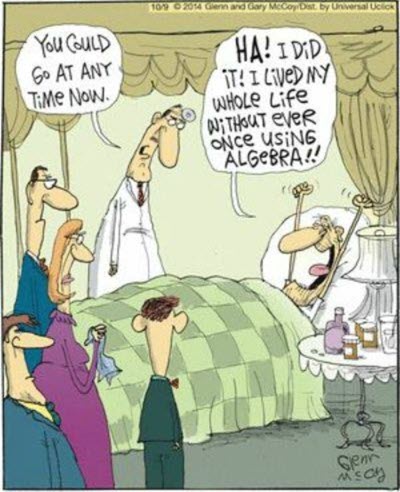
“I asked the same thing when I was in college taking German. Answer. IF you decide to get a PhD, then you MAY have to translate German mathematics papers for your dissertation. As Bill and Ted would say: BOGUS!” [5]
Schooling
The first question one should answer is: What am I going to do after I graduate? Answering that question should give you the basis for what mathematics you may need to complete while in school.
Many students may not know what they want to do after graduation. Some may have a goal of working in a certain profession, e.g., construction worker, engineering, law enforcement or teaching. However, goals in life can certainly change over time as people grow, experience new things, and re-evaluate their priorities. I have personally met many students and adults over the years that have changed their careers/goals while in school and even after a number of years in the workforce.
There are vocational schools that prepare you for a specific profession. Some colleges/universities have programs tailored for a student to work for a specific company. And some have work/study programs, internships and summer work programs.
However, schools typically offer a broad curriculum covering subjects like English, math, science, history, foreign languages, and the arts. The goal is to give students a solid base of knowledge across key disciplines. Why? Hopefully to prepare the student for whatever they will eventually do with their life after graduation.
“I couldn’t see how anyone could be educated by this self-propagating system in which people pass exams, and teach others to pass exams, but nobody knows anything.” – Richard Feynman
The Problems With Schools
In no particular order, these are the problems I have encountered, been told by individuals, or read about. They are not all inclusive.
- Teachers
- Teach what’s only in the book. The book usually does not all information on the subject, and may explain it only one way. Different students learn differently.
- May not have the depth of understanding to teach concepts only mechanics.
- Has to deal with bureaucracy that restricts what they teach, how to teach it, and consumes their time with paperwork.
- Spend more time controlling classroom than instruction.
- Classroom size. Need smaller teacher to student ratio.
- Professors
- Teach what’s only in the book. The book usually does not all information on the subject, and may explain it only one way. Different students learn differently.
- May not have the depth of understanding to teach concepts only mechanics because the mathematics subject is not their area of expertise, e.g., teaching differential equations when they research graph theory.
- Became professor to do research and not necessarily teach. Not required to take classes on how to teach, and may therefore not be the best at teaching.
- Publish or perish.
- Government
- Too much bureaucracy.Method of funding education.Standardized testing. Schools—and teachers—were judged by how well students scored on such tests. Not the best way to assess schools and teachers.
- School Boards
- Do not know how to address the problems facing the schools.
- Disregarding ideas from the school superintendent, teachers and staff.
- Supporting policies that are not in students’ best interests.
- Parents
- Parent involvement.
- What is going on at home will impact a student’s propensity to learn.
- Students
- Student attitudes, such as apathy and disrespect for teachers.
“The illiterate of the 21st century will not be those who cannot read and write, but those who cannot learn, unlearn and relearn.” – Alvin Toffler
The Goal of Education

Schools should aim to prepare individuals to be lifelong learners in a world where the nature of work will constantly change over individuals’ lifetimes. Equipping students to be self-directed, curious learners enables them to continue their education and development long after leaving the formal school system. This is what will make them successful.
I believe many schools miss this goal.
“I cannot teach anybody anything, I can only make them think.” ~ Socrates
Epilogue
To start off, Bella L wrote, “Because not only do I struggle to see how what I study will benefit my career, I also fail to see how the very specific type of thinking in mathematics can enrich and broaden my cognitive abilities.” [1]
While formal education is invaluable, the richness and depth that life experiences bring are essential for transforming knowledge into wisdom and becoming a truly lifelong learner. I am a lifelong learner [MM1]. I have made a number of career changes and I can attest to the fact that my mathematical schooling has assisted me in all aspects of my life. I would like to point out what I Love Math published on the When will I ever use this? Math Bulletin Board. The board contains 21 skills and mathematical practices that highlight the fact that much of mathematics may not be directly applicable to everyday life, mathematics can teach you to solve problems and persevere, which are skills you will use every day! Mathematics is just the course to develop these skills.
Do not let schooling be boring. Take charge of your life and what you want to do with it. Be a person who is a lifelong learner. You will never be bored.
“The problem is not the problem, the problem is your attitude about the problem.” – Jack Sparrow, Pirates of the Caribbean
Mathematics may not be the end goal for some, for me and others it is a means to an end. Pursuing personal interests, hobbies, and passions is an important part of a fulfilling life. Nurturing a love of learning can empower individuals to continue exploring areas that captivate them even after formal schooling ends.
Note what writer and wildlife photographer Jason Polack stated: “After being away from research and becoming a wildlife photographer, I gained enough mental space to think about it, and realize the true underlying cause of my departure from research mathematics. I hope math can change for the good of society, and I’m still very happy that I got my PhD because it was a personal goal of mine, but I’m glad I left.” [2]
While in school, or even after graduation, you change. Let your experiences guide you. What you want and like today may not be the same tomorrow. And remember, math is fun whether you do mathematics as a profession or enjoy it as recreation!
“As soon as something stops being fun, I think it’s time to move on. Life is too short to be unhappy. Waking up stressed and miserable is not a good way to live.” ― Richard Branson
References
[1]  L, Bella. 2024. “I don’t like mathematics enough.” Medium. My Notes. July 19. https://medium.com/bellas-ramblings/i-dont-like-mathematics-enough-284d8c8b67e6.
[2] Polak, Jason. 2024. “Why I left academic mathematics.” Medium. Medium. April 12. https://medium.com/@jpolak/why-i-left-mathematics-and-academia-1bd039087f95.
[3] Scott Kim. 2024. “Joyful Mathematics – What It Is and How to Spread It.” Scott Kim. Scott Kim. February 10. https://www.scottkim.com/post/joyful-mathematics-what-it-is-and-how-to-spread-it.
[4] “Why Are Some People Not Interested in Mathematics? I Find It Interesting.” 2024. Quora. Accessed July 20. https://www.quora.com/Why-are-some-people-not-interested-in-mathematics-I-find-it-interesting.
[5] Zeke the Geek. 2024. “What We’ve Got Here Is Failure to Communicate (Mathematically).” Mathematical Mysteries. April 13. https://mathematicalmysteries.org/2024/04/13/what-weve-got-here-is-failure-to-communicate-mathematically/.
[6] Barton, Paul E., and Richard J. Coley. “The Mission of the High School. A New Consensus of the Purposes of Public Education?”. 2011. Educational Testing Service. https://www.ets.org/Media/Research/pdf/PIC-MISSION.pdf.
Additional Reading
[AR1] Burdman, Pamela. 2021. “Numbers Evoke Joy and Wonder, Why Doesn’t Math Class?” The Hechinger Report. April 8. https://hechingerreport.org/opinion-why-doesnt-math-evoke-joy/.
Despite improvements in recent years, large numbers of students still score poorly on tests of mathematical skills and understanding. But more concerning — and perhaps even at the root of poor math performance — are the negative experiences that too many students have. Reasons given by teens to stop pursuing math include statements like “I despise the way it is taught” and “I have no confidence.” According to surveys, the majority of Americans dislike and fear math.
[AR3] “Why Do I Not Love Math Anymore?” 2024. Quora. Accessed July 20. https://www.quora.com/Why-do-I-not-love-math-anymore.
The primary reason that mathematicians (at least the great one) doing math is they find doing math is fun. If you find doing math is fun, then go ahead. If not, then it didn’t hurt to learn some math. It doesn’t really matter if you decide your career while in undergrad. You’re there to develop a strong baseline and to learn about what you don’t know yet. Honestly the one piece of advise I give to most undergrads is to take more math courses, even if it’s unrelated to their field of study, because math will open doors that most people won’t venture down. You don’t need to be a mathematician to major in math. I majored in math and marine biology and it was the best decision because it set me apart from other “pure science” undergrads when I was applying for grad school. So you don’t need to know if you’re going to “become a mathematician” because your goal right now should be to absorb as much information as you can so that you can apply it to the field you end up in, be it math or something else. – Poonam Gaba
[AR2] Lim, Russell. “What Are The Most Useful (And Useless) Topics In High School Math?” 2022. Medium. https://www.cantorsparadise.com/what-are-the-most-useful-and-useless-topics-in-high-school-math-18cf2cc6ff5f#c7f8.
[AR4] “Why Is Math so Hard for Some Students?” 2024. prodigygame.com. Accessed July 20. https://www.prodigygame.com/main-en/blog/math-is-hard/.
No school subject divides children more than math.
[AR5] Singh, Sunil. 2017. “I Love Math, but Quit Teaching It Because I Was Forced to Make It Boring.” The Globe and Mail. The Globe and Mail. October 9. https://www.theglobeandmail.com/life/facts-and-arguments/i-love-math-but-quit-teaching-it-because-i-was-forced-to-make-it-dull-andbanal/article36526126/.
[AR6] Singh, Sunil. 2024. “Why I Am Walking Away From Mathematics Education - It’s A Toxic Relationship.” Medium. Medium. July 21. https://sunilsingh-42118.medium.com/why-i-am-walking-away-from-mathematics-education-its-a-toxic-relationship-8187538a0ade.
Schools must stop trying to sell its usefulness – it’s not why anyone should learn math.
[AR7] “Why Do I Hate Mathematics So Much? And How to Fix It.” 2023. Geekyplix. May 31. https://geekyplix.com/why-do-i-hate-math-so-much-and-how-to-fix-it/.
Mathematics is a subject that most people hate. Students struggling are likely to say things like, “Why do I hate math so much?” Below are the most common reasons that make students hate math.
Mathematical Mysteries
[MM1] Zeke the Geek. 2023. “Fifty Years of Change, or How I Learned to Stop Worrying and Love Mathematics.” Mathematical Mysteries. August 16. https://mathematicalmysteries.org/2023/06/27/fifty-years-of-change-or-how-i-learned-to-stop-worrying-and-love-mathematics/.
I just realized that it has been 50 years (1973 – 2023) since I graduated from high school and there have been many changes over the years. What follows are my experiences relearning mathematics after retirement, tutoring and substitute teaching, and limiting my discussion to Mathematical Concepts, Teaching and College. Why these three? As I look back, I have concluded, with my 14+ years of education, I was not taught mathematical concepts, how to use the mathematics, and how I “failed” college. The following observations may not be indicative of every subject or school but what I have noted over the past few years.
[MM2] Zeke the Geek. 2023. “Why Do Students Find Mathematics Difficult?” Mathematical Mysteries. https://mathematicalmysteries.org/2022/05/11/why-do-students-find-mathematics-difficult/.
“When one looks at the scientific evidence about how the brain learns and at the design of our education system, one is forced to conclude that the system actively retards education” – DAISY CHRISTODOULOU
[MM3] Zeke the Geek. 2023. “Why Do Students Find Mathematics Difficult? – Part 2.” Mathematical Mysteries. August 30. https://mathematicalmysteries.org/2022/10/08/why-do-students-find-mathematics-difficult-part-2/.
As brought out in the first editorial, there is no one reason why students find mathematics difficult, BUT there are many external reasons why mathematics is MADE difficult. Since I wrote that editorial, I have learned a few things that I would like to pass on.
[MM4] Zeke the Geek. 2023. “Who Are You?” Mathematical Mysteries. July 22. https://mathematicalmysteries.org/2022/07/14/who-are-you/.
Even in college I did not know what I wanted to be, or do with the math I learned. I just knew that I wanted to go to college and study mathematics! In my undergraduate studies (applied mathematics) and obtaining my master’s degree (operations research, statistics and management), I studied and enjoyed mathematics. Yet, I still did not know what I wanted to do with it. Life took me in many directions and led me to retirement, rekindling my love for mathematics and helping others with the information in this website.
[MM5] Zeke the Geek. 2024. “‘Would You Tell Me, Please, Which Way I Ought to Go from Here?’” Mathematical Mysteries. https://mathematicalmysteries.org/2021/11/29/would-you-tell-me-please-which-way-i-ought-to-go-from-here/.
When I was in high school, I enjoyed math and wanted to pursue it as a career. I also felt a lot like Alice, I almost received the same response as she did from the Cheshire Cat when I asked the guidance counselor, math teachers and others what math classes to take, what opportunities were open to me with a math degree, and what math I should know, e.g., algebra, calculus, geometry, trigonometry, probability, statistics, and accounting. I was on my own. One thing I learned once I took the SAT and ACT, and was actually in college, is that I not only needed specific math courses, but the courses should have taught specific topics, e.g., arithmetic and geometric sequences, estimating, significant digits, PEMDAS, and set theory. Some of these I had to learn on my own because my high school did not teach some of these skills and concepts.
[MM6] Zeke the Geek. 2024. “It Is Not in Our Stars To Hold Our Mathematical Destiny but Ourselves.” Mathematical Mysteries. June 1. https://mathematicalmysteries.org/2024/06/01/it-is-not-in-our-stars-to-hold-our-mathematical-destiny-but-ourselves/.
Why am I convinced that the “ish” way of mathematics will work? Not only are many of the concepts being successfully used by teachers (even before Jo Boaler wrote this book [Math-ish: Finding Creativity, Diversity, and Meaning in Mathematics]), and they are concepts I have used over the years to learn new things (e.g., computer programming, art appreciation, and additional mathematics) that I did not study in an institute of learning.
[MM7] Zeke the Geek. 2024. “My Math Teacher/Professor Is Terrible at Explaining.” Mathematical Mysteries. June 30. https://mathematicalmysteries.org/2024/06/14/my-math-teacher-professor-is-terrible-at-explaining/.
Unfortunately, education cannot be downloaded into your brain. Education requires effort and studying. If you don’t study you aren’t going to do well. Contrary to popular belief, getting an education is not the same as working a job, you have to do some things outside regular school hours or you aren’t doing it right. – Rebecca T.
Medium Member Only
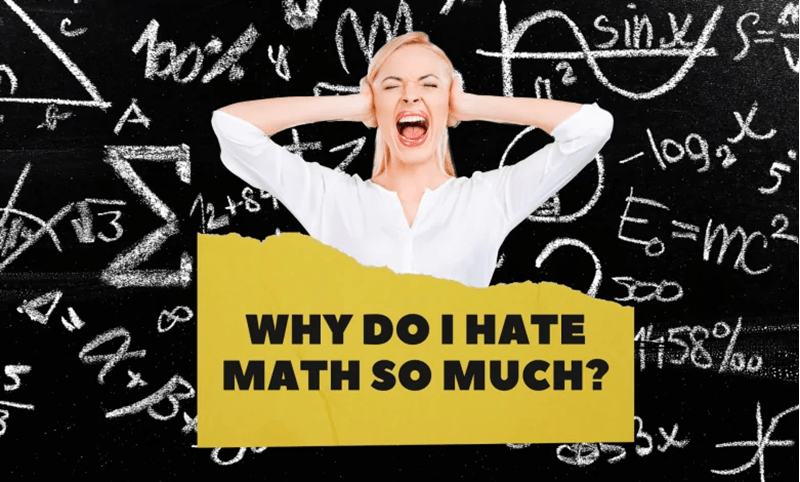
The featured image on this page is from the Geekyplix website.
 Mathematical Mysteries