
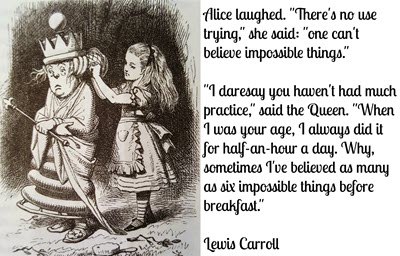
Most people know Lewis Carroll (Charles L. Dodgson) as the author of Alice’s Adventures in Wonderland (1865) and its sequel Through the Looking-Glass, and What Alice Found There (1871). What many do not realize is that Charles Dodgson was primarily a mathematical lecturer at Oxford University during much of the Victorian era. As a college professor, he began teaching the geometry of Euclid’s Elements, wrote many pamphlets to supplement the original text, and provide additional exercises. As a mathematician, he explored algebra and analytic geometry. As a writer, he often blended his mathematical skills with his whimsical style. This writing style is evident in his two books whose main protagonist, Alice, is trying to make sense of the bizarre worlds to where she is transported. Worlds of mathematical possibilities, impossibilities, and imagination.
Since many are trying to make sense of mathematical possibilities, impossibilities, and imagination like Alice, let’s start with the teaching of mathematics. That is where creativity, impossibilities and imagination are undermined. [4][5][6]
When mathematics is taught, the focus is on formulas, which can make it challenging to see how they relate to real-world situations. Without the ability to connect mathematics to practical applications, some individuals may struggle to find motivation or see the relevance of the subject.
“Kids are under pressure to achieve academically and outside of school and are overstimulated, overscheduled, and overworked. This limits their capacity to develop critical thinking abilities necessary for self-discovery. Creativity happens when kids have the leisure to be curious and explore. However, opportunities for growth are stunted since kids spend up to eight hours a day using media devices and another eight hours participating in scheduled activities.” [5]
What happens when the student is exposed to more advanced areas of mathematics? If one lacks a solid foundation or understanding of earlier concepts, e.g., problem-solving skills, the understanding of abstract concepts, and an understanding of symbolic language, then some students will find it difficult to grasp and apply mathematical principles. For example, mathematics often deals with abstract concepts and ideas that are not directly observable in the physical world. Mathematics also involves problem-solving and critical thinking skills. These require logical reasoning, creativity, and the ability to break down complex problems into smaller, manageable steps.
So what can we do? Let’s consider mathematics as an art. Why? Art, like mathematics, often thrives on pushing boundaries and challenging what is considered possible. Artists have continually surprised us with their innovative approaches and ability to transcend limitations, so what may seem impossible today could become a reality in the future.
Art and Mathematics
Mathematics is often described as both a science and an art. While it is commonly viewed as a precise and logical discipline, there are also artistic elements inherent in mathematics.
Mathematics can be seen as an art form because it involves creativity, imagination, and aesthetic appreciation. Mathematicians often engage in creative problem-solving, devising new theorems, and developing elegant proofs. The process of discovering and proving mathematical results requires imagination and the ability to think abstractly.
Furthermore, mathematics exhibits beauty and elegance in its patterns, symmetries, and structures. Mathematicians often describe the beauty of a mathematical idea or proof, and they appreciate the elegance and simplicity of mathematical concepts. Just like an artist, mathematicians strive to create something aesthetically pleasing and intellectually satisfying.
Moreover, mathematics can be expressed and communicated through various visual representations, such as diagrams, graphs, and geometric figures. These visual representations can be considered artistic in nature, as they convey mathematical ideas in a visually appealing and intuitive manner.
While mathematics is grounded in rigorous logic and reasoning, it also possesses artistic qualities. It involves creativity, imagination, aesthetic appreciation, and the creation of visually appealing representations. The interplay of these aspects contributes to the view of mathematics as both a science and an art.
Art
Imagination is a fundamental aspect of art. It empowers artists to conceive original ideas, interpret the world, innovate, visualize, problem-solve, and engage the audience. It is the wellspring of creative expression and a catalyst for artistic exploration and discovery.
Music
Ludwig van Beethoven’s deafness is probably the best-known physical ailment of any composer in history. It has even been said that after Beethoven could no longer hear, he retreated into the privacy of his imagination, heard music in his head, then wrote it down. [1]
Sculpture
Michelangelo stated, “The sculpture is already complete within the marble block, before I start my work. It is already there, I just have to chisel away the superfluous material.”
Painting
Vincent Van Gogh once said, “I dream of painting and then I paint my dream.”
Mathematics
Imagination helps mathematicians conceptualize abstract ideas, visualize mathematical objects and relationships, engage in creative problem-solving, explore new avenues of mathematical inquiry, construct proofs, and communicate mathematical concepts effectively. Imagination fuels the curiosity and creativity that drive mathematical exploration and discovery.

Like the artists above, do mathematicians “see” how to solve a given problem? For example, do mathematicians see that a coffee mug and a donut are the same topologically? Some do. Mathematicians often visualize abstract mathematical objects and structures in their minds. They use mental imagery to explore mathematical relationships, patterns, and proofs. Mathematicians can “see” patterns, structures, and relationships in mathematical objects and equations. Furthermore, mathematicians often describe their work in terms of visual metaphors and analogies. They use visual representations such as graphs, diagrams, and geometric shapes to communicate and explain mathematical concepts. These visualizations can help mathematicians and others to better understand and appreciate the underlying mathematical ideas.
When mathematician David Hilbert learned that one of his students dropped out of his mathematics programme to pursue poetry, he said:
“Good, he did not have enough imagination to become a mathematician.”
Hilbert did not note a lack of work, or a lack of interest, or a lack of enthusiasm in this student: he noted a lack of imagination. This lack of imagination led Hilbert to not express any surprise when that student left his programme; indeed, you could say that Hilbert endorsed this student’s exit.
In most high school programmes, the instructor asks students to solve problems that were already solved by himself or herself in class. This is not what a real mathematician does — indeed, mathematicians do the opposite; they largely solve problems that nobody else has solved before. Having a high level of imagination that makes you look at things in a different and novel way from how everyone else had looked at the problem is what helps a mathematician to solve such problems. This is the imagination that Hilbert was talking about. [2]
“Imagination is more important than knowledge. For knowledge is limited to all we know and understand, while imagination embraces the entire world, and all there ever will be to know and understand.” – Albert Einstein
Post Hoc, Ergo Propter Hoc
Imagination plays a crucial role in solving mathematical problems. Mathematicians often use their imagination to visualize abstract concepts, create mental models, and explore new ideas. For example, when solving geometry problems, mathematicians often use their imagination to visualize shapes and their relationships in space. In algebra, imagination can be used to visualize the behavior of mathematical functions and their graphs. In advanced mathematics, such as topology or abstract algebra, imagination is essential for understanding complex structures and relationships. Overall, imagination in mathematics allows mathematicians to think creatively, form new hypotheses, and develop innovative solutions to mathematical problems. [3]
“The mathematician’s best work is art, a high perfect art, as daring as the most secret dreams of imagination, clear and limpid. Mathematical genius and artistic genius touch one another.” – Gosta Mittag-Leffler
It’s important to note that while imagination is valuable in mathematics, it is not the only tool used. Rigorous logical reasoning, proof techniques, and mathematical structures are also integral to the discipline. Imagination serves as a complement to these tools, enhancing the understanding and exploration of mathematical concepts.
References
[1] Parr, Freya. 2024. “How Did Beethoven Cope with Going Deaf?” Classical Music. Accessed April 27. https://www.classical-music.com/features/composers/how-did-beethoven-cope-going-deaf.
[2] Farrugia, Alexander. “Do we use imagination to solve mathematical problems or generally use imagination in mathematics, if so, how and what are the examples?” 2024. Quora. Accessed April 26. https://qr.ae/psuqdx.
[3] “Do we use imagination to solve mathematical problems or generally use imagination in mathematics, if so, how and what are the examples?” 2024. Quora. Accessed April 26. https://qr.ae/ps5G68.
[4] “Imagination Is a Skill We Develop, Not a Trait We Lose.” 2024. Psychology Today. Sussex Publishers. Accessed May 18. https://www.psychologytoday.com/us/blog/inconceivable/202312/imagination-is-a-skill-we-develop-not-a-trait-we-lose.
In fact, scores of studies demonstrate that children’s imagination is impoverished. Children have the capacity to entertain novel possibilities but not the tools. The tools come from knowledge, learned from others, which allow us to transcend our beliefs about what is true and contemplate ideas about what could be true.
[5] “Are Kids Losing the Magic of Imagination?” 2024. Varthana. https://varthana.com/school/are-kids-losing-the-magic-of-imagination/.
[6] Cairney, Trevor. 2024. “The Slow Death of Imagination and Creativity at School – Part 1”. Accessed May 18. https://trevorcairney.blogspot.com/2020/07/the-slow-death-of-imagination-and.html.
Within a year or two of the commencement of school the die is cast. The pressure to learn what is seen as the basics, increasingly dominates all that most parents and schools end up doing. With each passing year, less freedom is allowed for children to imagine and explore ‘what if’? What might be? How might schools do this? I will offer just five ways that schools can potentially kill imagination and creativity.
Additional Reading
Allum, Heidi. 2018. “Developing Mathematical Imagination in Classrooms.” Medium. Q.E.D. December 2. https://medium.com/q-e-d/developing-mathematical-imagination-in-classrooms-d67f934ded13.
Mehrotra, Pronita. 2023. “5 Simple Ways to Add Creativity in Mathematics.” edCircuit. February 16. https://edcircuit.com/five-simple-ways-to-add-creativity-in-mathematics/.
In fact, research has shown that creativity can actually help students acquire content knowledge. But, how can we encourage creativity in mathematics, a subject usually considered linear and inflexible? Several researchers have found ways to make math more creative, fun and engaging. Here are five simple ways to add more creativity in mathematics.
Singh, Sunil. 2024. “Mathematics Education Is A Fearful Echo Chamber of Compliance: It’s Time For A New Model.” Medium. Medium. May 19. https://sunilsingh-42118.medium.com/mathematics-education-is-a-fearful-echo-chamber-of-compliance-its-time-for-a-new-model-4a95f93d1b48.
We have ‘jumped the shark’ in terms of rigidity and conformity. We have supplanted creativity with compliance. We have distilled the connection between learners and between teachers and learners down to an algorithm. There is little belief in or understanding of the alchemy of passion, relationship, trust, curiosity, and play that lies at the heart of our work as educators. There is an art, dare I say a certain magic to great teaching. Consequently, there is a beauty and organic nature to the learning that comes out of a great classroom culture that (I believe) defies easy description or mass duplication. We have lost our way it seems, because the path of learning needs to be straight to satisfy our current masters — and we all know that there are many crooked paths and dead-ends before we reach the most secret and sacred places. – Mark Sonneman
“The Surprising Benefits of Imaginative Play.” 2021. Little Sunshine’s Playhouse and Preschool. September 23. https://littlesunshine.com/the-surprising-benefits-of-imaginative-play/.
Videos
Sir Ken Robinson makes an entertaining and profoundly moving case for creating an education system that nurtures (rather than undermines) creativity.
“Fast, Helpful AI Chat.” 2024. Poe. Assistant. Accessed April 27. https://poe.com/.

I used AI bots in this article to capture ideas that I could not develop on my own without more extensive research. I recall back in the 1990s attending presentations at conferences where the presenter was using crawler bots to gather information for their research. I am still experimenting with AI bots, and will continue to use them as needed to present ideas and concepts more clearly to the reader.
The featured image depicts Sophiya Kovalevskaya, the first woman to obtain a doctorate (in the modern sense) in mathematics, the first woman appointed to a full professorship in northern Europe and one of the first women to work for a scientific journal as an editor.
 Mathematical Mysteries