
Compose yourself, Müller, and answer me distinctly. Do I understand that he asked for more, after he had thoroughly read The Areas of Mathematics Explained?

Slowly and fearfully Oliver Twist gets up from his seat and moves toward the object of his fear. He is driven forward by hunger.
The pain of staying the same has finally overcome the pain of the change he wants. No one has done this before – at least they haven’t done this and not suffered any consequences.
The object of his fear is also the only one who can help him. Will he be punished or rewarded? He doesn’t really know, but he is willing to find out.
Slowly, cautiously, fearfully, timidly, yet tenaciously he approaches the one to whose authority he must submit. He doesn’t really like this, but he has no option. So, ‘cap in hand’, he makes his way forward in the hopes that he won’t be rejected, or worse, punished for simply wanting a better life.
Does he deserve a better life? Probably not. Has he earned a better life? Probably not. Does he even have the right to ask for more? Probably not again. The cards are stacked against him, but his hunger is relentless.
He makes his way to front, lifts his bowl and asks the stern, angry and fear inducing master for more food:
“Please sir, I want some more.” [1]
The Areas of Mathematics Explained
After I read Kasper Müller’s article “The Areas of Mathematics Explained” [2], I felt like Oliver Twist. I wanted more. I thoroughly enjoyed the article, and understand that the article was meant “as a small guided tour that should make the areas of mathematics more clear.” However, I needed a little more information to make the article more clear to me. As usual, I did some research and I present those findings below to those who “want some more.”
Number Theory
One thing that I do not remember being taught is that prime numbers are the building blocks of arithmetic because no matter what natural number you may think of, you can express it as product of prime numbers. For instance, take 30, it can be decomposed as 2·3·5. Or 123456 in 2^6·3·643. The process of decomposing a number to its prime number factors is called it factorization.
“Number theory is, among other things, concerned with exploring the multiplicative structure of the natural numbers. The reason for this is that these numbers turn out to have a multiplicative DNA – a unique recipe that describes them completely as built from base numbers called prime numbers. This mimics how DNA is built from base molecules and the idea is that to understand natural numbers, we try to understand the prime numbers.”
How many primes are there? Infinitely many! [6] A search for a better approximate distribution of the primes is ongoing and the ultimate such result which many believe to be true is called the Riemann Hypothesis, however, this remains unsolved to this day. [2]
Where can you learn about the Riemann Hypothesis? A “simple” explanation of prime numbers and the Riemann Hypothesis is found in Jørgen Veisdal article [3].
The properties of the prime numbers have been studied by many of history’s mathematical giants. From the first proof of the infinity of the primes by Euclid, to Euler’s product formula which connected the prime numbers to the zeta function. From Gauss and Legendre’s formulation of the prime number theorem to its proof by Hadamard and de la Vallée Poussin. Bernhard Riemann still reigns as the mathematician who made the single biggest breakthrough in prime number theory. His work, all contained in an 8 page paper published in 1859 made new and previously unknown discoveries about the distribution of the primes and is to this day considered to be one of the most important papers in number theory.
Since its publication, Riemann’s paper has been the main focus of prime number theory and was indeed the main reason for the proof of something called the prime number theorem in 1896. Since then several new proofs have been found, including elementary proofs by Selberg and Erdós. Riemann’s hypothesis about the roots of the zeta function however, remains a mystery.
Geometry
The statement in the article that surprised me is as follows.
“Geometry is one of the first fields to be axiomatized (put on a rigorous foundation again by the ancient Greeks) and is in that sense historically the first instance of modern mathematics.” [2]
The reason for my surprise is I just discovered that mathematics, not just geometry, is axiomatic! When was I ever taught this? NEVER! I am speaking about high school, college and graduate school. If you are not familiar with an axiomatic system, you may want to investigate an axiomatic system as I will.
Hear are the different geometries according to Wikipedia unless otherwise noted.
- Algebraic Geometry
- Complex Geometry
- Computational Geometry
- Convex Geometry
- Differential Geometry
- Discrete Geometry
- Euclidean Geometry
- Euclidean Vectors
- Geometric Group Theory
- Hyperbolic Geometry (MAA)
- Non-Euclidean Geometry
- Plane Geometry (BYJU’S)
- Projective Geometry (Wikipedia)
- Solid Geometry (BYJU’S)
- Spherical Geometry (Wikipedia)
- Topology
Algebra
Algebra is one of my favorite subjects. I do not want to dwell on this area of mathematics but expound on the following paragraph because that is what interested me.
In hundreds of years, the Persian, Arabic, and Indian mathematicians matured this discipline while Europe and the rest of the world practically stood still. Then in the 13th century, traveling salesmen from the Arabic world passed their knowledge of algebra to Europe where the church and academic culture made sure that the spread of knowledge was blocked for about 300 years. In Italy, the Hindu-Arabic numerals (our modern numbers) were even illegalized for a period! Imagine being sent to prison for writing down “2” instead of “II”. [2]
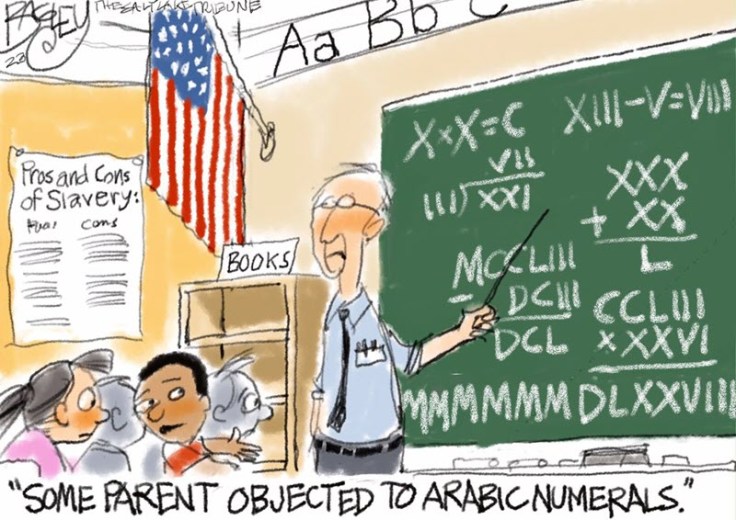
Here is one explanation why the spread of mathematical knowledge was blocked for about 300 years.
The Medieval time period is often referred to as the “Dark Ages” partly because of the notion that it lacked scientific or technological advancement. This is largely due to the rise of the Christian Church that took control of almost all aspects of life including religious, government and scientific functions of the Roman Empire (McCall, 2018). Religion from a scientific standpoint was only to get closer to God and unveil His creations (McCall, 2018). The Catholic Church during the Middle Ages hindered scientific advancement because it feared that scientific reasoning would threaten its authority; however the introduction of new technologies was not seen as such of a threat and was integrated into people’s lives such as the invention of the chimney. Scientific reasoning for natural phenomenon could have called into question the Church’s place of power. This is why certain scientific practices were strictly controlled by the church, like that of human dissections for learning the anatomy of the body. [4]
Analysis and Calculus
I am still reeling trying to wrap my head around the difference between Analysis and Calculus. Based on the definitions provided, I am sure that I have taken classes in each of these areas during my undergraduate studies. Here are some definitions about each to get you started in your quest for additional information.
Mathematical Analysis therefore deals with functions, limits, variables. This is done in a logical-symbolic and formal way. On the other hand, Calculus deals with quantities that vary in magnitude, rate of change and accumulation. The quantities covary with each other and have dimensions and units. [5]
“Mathematical analysis” can refer to real analysis, complex analysis, functional analysis, abstract analysis, etc. Calculus (especially when being used as a word today) refers to the single/multivariable Leibniz/Newtonian calculus taught in high school and first year university courses for science/social science majors, which is split up into differential calculus (studying functions that are differentiable and that can be approximated by linear functions) and integral calculus (functions that are integrable) on ℝn. [7]
Analysis is the branch of mathematics dealing with continuous functions, limits, and related theories, such as differentiation, integration, measure, infinite sequences, series, and analytic functions. These theories are usually studied in the context of real and complex numbers and functions. Analysis evolved from calculus, which involves the elementary concepts and techniques of analysis. [8]
Calculus is the mathematical study of continuous change, in the same way that geometry is the study of shape, and algebra is the study of generalizations of arithmetic operations. Originally called infinitesimal calculus or “the calculus of infinitesimals”, it has two major branches, differential calculus and integral calculus. The former concerns instantaneous rates of change, and the slopes of curves, while the latter concerns accumulation of quantities, and areas under or between curves. These two branches are related to each other by the fundamental theorem of calculus, and they make use of the fundamental notions of convergence of infinite sequences and infinite series to a well-defined limit. [9]
Topology
I am not going to say much about topology because I do not know much about it and will be studying more about it in the future. Here is a good “definition” of topology.
Topology is a fundamental mathematical discipline where we study “shapes” but the parameters of interest are not size, angle, curvature, or smooth functions as are of fundamental interest in geometry.
Instead, we are interested in the classification of shapes up to stretching, bending, and gluing (to some extent) but not tearing and cutting. The maps of interest are not required to be smooth (preserving geometry) but rather continuous (preserving topology). In that sense, topology is more “fundamental” than geometry. [10]
However, I do remember my roommate in college asking me if I understood the following theorem. He was taking topology at the time and he was WAY smarter than I was.
One of the most useful theorems in mathematics is an amazing topological result known as the Brouwer Fixed Point Theorem. Take two sheets of paper, one lying directly above the other. If you crumple the top sheet, and place it on top of the other sheet, then Brouwer’s theorem says that there must be at least one point on the top sheet that is directly above the corresponding point on the bottom sheet! Do you believe that? [11]
I said yes, that made sense to me but I could not prove it. He was amazed because he could not visualize what the theorem was describing and he was not sure how to prove it.
Discrete Mathematics
Discrete mathematics is another area of mathematics that I was not totally familiar with but I have studied a number of areas, e.g., Set Theory, Graph Theory, Permutations, Combinations, Sequences and Series. What I find amazing is the breadth and depth of mathematics that exists. Just looking at the list below tells me that I have a long way to go in my quest to understand the world of mathematics.
Discrete mathematics is a collection of several sub-disciplines spanning from combinatorics and graph theory to mathematical logic and axiomatic set theory. The thing they all have in common is that they are all about non-continuous mathematical objects (by “discrete” we mean not continuous). [2]
Included below are many of the standard terms used routinely in university-level courses and in research papers. This is not, however, intended as a complete list of mathematical terms; just a selection of typical terms of art that may be encountered. [12]
- Logic – Study of correct reasoning
- Modal logic – Type of formal logic
- Set theory – Branch of mathematics that studies sets
- Number theory – Mathematics of integer properties
- Combinatorics – Branch of discrete mathematics
- Finite mathematics – Syllabus in college and university mathematics
- Graph theory – Area of discrete mathematics
- Digital geometry – Deals with digitized models or images of objects of the 2D or 3D Euclidean space
- Digital topology – Properties of 2D or 3D digital images that correspond to classic topological properties
- Algorithmics – Sequence of operations for a task
- Information theory – Scientific study of digital information
- Computability – Ability to solve a problem in an effective manner
- Computational complexity theory – Inherent difficulty of computational problems
- Probability theory – Branch of mathematics concerning probability
- Probability – Branch of mathematics concerning chance and uncertainty
- Markov chains – Random process independent of past history
- Linear algebra – Branch of mathematics
- Functions – Association of one output to each input
- Partially ordered set – Mathematical set with an ordering
- Proofs – Reasoning for mathematical statements
- Relation – Relationship between two sets, defined by a set of ordered pairs
Finale
What did I learn that I can pass onto you?
- In my quest to provide you, the reader, more information about The Areas of Mathematics Explained, I did receive some more but not enough to feel satiated. I will continue my study of mathematics.
- I am more convinced that all mathematics is connected in some manner just as physicists are attempting to find the Unified Field Theory, mathematics is unified in some manner not yet found. (For a step forward in a unified mathematics, see the links below under Connections Between Mathematical Disciplines and Fermat’s Last Theorem.)
- I encourage all to see the links in Mathematical Areas and Videos below for additional attempts to describe the world of mathematics.
- I hope my feeble attempt to obtain more has stimulated you to do additional research.
“The mathematics we learn in school doesn’t quite do the field of mathematics justice – we only get a glimpse of one corner of it, but mathematics as a whole is a huge, and wonderfully diverse subject.”
Dominic Walliman
References
[1] “Please Sir, I Want Some More. – Wholehearted Men.” 2024. Wholehearted Men RSS. Accessed February 24. https://www.wholeheartedmen.com/please-sir-i-want-some-more/.
[2]  Müller, Kasper. 2024. “The Areas of Mathematics Explained.” Medium. Cantor’s Paradise. February 19. https://www.cantorsparadise.com/the-areas-of-mathematics-explained-8edef4695f64.
[3] Veisdal, Jørgen. 2020. “The Riemann Hypothesis, Explained.” Medium. Cantor’s Paradise. November 3. https://www.cantorsparadise.com/the-riemann-hypothesis-explained-fa01c1f75d3f.
[4] Amaker, Tyler, et al. 2020. “The Medieval World and STS.” Science Technology, & Society: A StudentLed Exploration. July 29. https://pressbooks.pub/anne1/chapter/the-medieval-world-and-sts/.
[5] Anatoli Kouropatov, Lia Noah-Sella, Tommy Dreyfus, Dafna Elias. An epistemological gap between Analysis and Calculus: the case of Nathan. Fourth conference of the International Network for Didactic Research in University Mathematics, Leibnitz Universität (Hanover), Oct 2022, Hannover, Germany. ffhal-04027849f
[6] “The Map of Mathematics – Atoms of Arithmetic.” 2024. Quanta Magazine. Accessed February 24. https://mathmap.quantamagazine.org/N1.1.
[7] noobProgrammer (https://math.stackexchange.com/users/61722/noobprogrammer), What on earth is the difference between Calculus and Analysis, URL (version: 2013-03-01): https://math.stackexchange.com/q/318162
[8] “Mathematical Analysis.” 2024. Wikipedia. Wikimedia Foundation. February 23. https://en.wikipedia.org/wiki/Mathematical_analysis.
[9] “Calculus.” 2024. Wikipedia. Wikimedia Foundation. March 6. https://en.wikipedia.org/wiki/Calculus.
[10] “Topology.” 2024. Brilliant Math & Science Wiki. Accessed March 9. https://brilliant.org/wiki/topology/.
[11] Su, Francis E., et al. “Brouwer Fixed Point Theorem.” 2024. Math Fun Facts. Accessed March 9. https://math.hmc.edu/funfacts/brouwer-fixed-point-theorem/.
[12] “Outline of Discrete Mathematics.” 2024. Wikipedia. Wikimedia Foundation. February 2. https://en.wikipedia.org/wiki/Outline_of_discrete_mathematics.
Discrete mathematics is the study of mathematical structures that are fundamentally discrete rather than continuous. In contrast to real numbers that have the property of varying “smoothly”, the objects studied in discrete mathematics – such as integers, graphs, and statements in logic – do not vary smoothly in this way, but have distinct, separated values. Discrete mathematics, therefore, excludes topics in “continuous mathematics” such as calculus and analysis.
Additional Reading
Mathematical Areas
“The Map of Mathematics – Numbers.” 2024. Quanta Magazine. Accessed February 24. https://mathmap.quantamagazine.org/.
Here is a map of mathematics as it stands today, mathematics as it is practiced by mathematicians.
From simple starting points — Numbers, Shapes, Change — the map branches out into interwoven tendrils of thought. Follow it, and you’ll understand how prime numbers connect to geometry, how symmetries give a handle on questions of infinity.
And although the map is necessarily incomplete — mathematics is too grand to fit into any single map — we hope to give you a flavor for the major questions and controversies that animate the field, as well as the conceptual tools needed to dive in.
There’s no right or wrong way to explore. You can go in a straight line from topic to topic, or jump around, searching for something that catches your eye.
If mathematics is the poetry of logical ideas, as Albert Einstein once wrote, then through this we hope to provide an appreciation for all the beauty that it describes.
TomRocksMaths. 2021. “Mathematopia: The Adventure Map of Mathematics.” TOM ROCKS MATHS. February 25. https://tomrocksmaths.com/2020/12/21/mathematopia-the-adventure-map-of-mathematics/.
Number Theory
Agramunt-Puig, Sebastia. 2020. “Prime Numbers.” Medium. Medium. October 10. https://medium.com/@sebastiaagramunt/prime-numbers-7eab54534809.
Prime numbers are the building blocks of arithmetics. In this short post we will investigate some attributes of prime numbers and how to work with them in a computer.
My fellow warriors and adventurers!
Grab your sword and shield,
And then I shall unfold to you
the scroll of the grand spectacle
of the most magnificent terrain of
Mathematopia!
“Number Theory.” 2024. KidzSearch.Com. Accessed March 21. https://wiki.kidzsearch.com/wiki/Number_theory.
Number theory is a part of mathematics. It explains what some types of numbers are, what properties they have, and ways that they can be useful.
Geometry
See the links in the Geometry section above.
“Euclidean Geometry (Definition, Facts, Axioms and Postulates).” 2021. BYJUS. BYJU’S. September 20. https://byjus.com/maths/euclidean-geometry/.
Euclidean geometry is the study of geometrical shapes (plane and solid) and figures based on different axioms and theorems. It is basically introduced for flat surfaces or plane surfaces. Geometry is derived from the Greek words ‘geo’ which means earth and ‘metrein’ which means ‘to measure’.
Euclidean geometry is better explained especially for the shapes of geometrical figures and planes. This part of geometry was employed by the Greek mathematician Euclid, who has also described it in his book, Elements. Therefore, this geometry is also called Euclid geometry.
“Geometry.” 2023. Mathematics LibreTexts. October 1. https://math.libretexts.org/Bookshelves/Geometry.
Geometry is one of the oldest branches of mathematics and is concerned with properties of space that are related with distance, shape, size, and relative position of figures.
“Geometry.” 2024. KidzSearch.Com. Accessed March 21. https://wiki.kidzsearch.com/wiki/Geometry.
Geometry (from Ancient Greek: Γεωμετρία (romanized: Geometria (English: “Land measurement”) derived from Γη (romanized: Ge; English: “Earth” or “land”) and also derived from Μέτρον) (romanized: Métron; English: “A measure”)) is a branch of mathematics that studies the size, shapes, positions and dimensions of things.
“Geometry (All Content).” 2024. Khan Academy. Khan Academy. Accessed March 14. https://www.khanacademy.org/math/geometry-home.
“What Is Geometry? Plane & Solid Geometry: Formulas & Examples.” 2023. BYJUS. BYJU’S. https://byjus.com/maths/geometry/.
Geometry is the branch of mathematics that deals with shapes, angles, dimensions and sizes of a variety of things we see in everyday life. Geometry is derived from Ancient Greek words – ‘Geo’ means ‘Earth’ and ‘metron’ means ‘measurement’. In Euclidean geometry, there are two-dimensional shapes and three-dimensional shapes.
In a plane geometry, 2d shapes such as triangles, squares, rectangles, circles are also called flat shapes. In solid geometry, 3d shapes such as a cube, cuboid, cone, etc. are also called solids. The basic geometry is based on points, lines and planes explained in coordinate geometry.
The different types of shapes in geometry help us to understand the shapes day to day life. With the help of geometric concepts, we can calculate the area, perimeter and volume of shapes.
Algebra
“Algebra.” 2024. KidzSearch.Com. Accessed March 21. https://wiki.kidzsearch.com/wiki/Algebra.
Algebra (from Arabic: الجبر, transliterated “al-jabr”, meaning “reunion of broken parts”) is a part of mathematics. It uses variables to represent a value that is not yet known or can be replaced with any value. When an equals sign (=) is used, this is called an equation. A very simple equation using a variable is: 2+3=x. In this example, x=5, or it could also be said that “x equals five”. This is called solving for x.
Stapel, Elizabeth. 2024. “Struggling with Algebra Concepts or Methods? Help Is Here!” Purplemath. Accessed March 14. https://www.purplemath.com/.
Purplemath’s algebra lessons are informal in their tone, and are written with the struggling student in mind. Don’t worry about overly-professorial or confusing language! The free lessons on this math website emphasize the practicalities rather than the technicalities, demonstrating dependably helpful techniques, warning of likely “trick” test questions, and pointing out common student mistakes.
Analysis and Calculus
“Analysis.” 2024. KidzSearch.Com. Accessed March 21. https://wiki.kidzsearch.com/wiki/Analysis.
Analysis is the process of breaking a complex topic or substance into smaller parts to gain a better understanding of it. The technique has been applied in the study of mathematics and logic since before Aristotle (384–322 B.C.), though analysis as a formal concept is a relatively recent development.
The word comes from the Ancient Greek ἀνάλυσις (analusis, “a breaking up”, from ana- “up, throughout” and lysis “a loosening”).
In this context, Analysis is the opposite of synthesis, which is to bring ideas together.
“Calculus.” 2024. KidzSearch.Com. Accessed March 21. https://wiki.kidzsearch.com/wiki/Calculus.
Calculus is a branch of mathematics that describes continuous change. There are two different types of calculus. Differential calculus divides (differentiates) things into small (different) pieces, and tells us how they change from one moment to the next, while integral calculus joins (integrates) the small pieces together, and tells us how much of something is made, overall, by a series of changes. Calculus is used in many different sciences such as physics, astronomy, biology, engineering, economics, medicine and sociology.
“Mathematical Analysis.” 2024. Wikipedia. Wikimedia Foundation. February 23. https://en.wikipedia.org/wiki/Mathematical_analysis.
Topology
“Topology.” 2024. KidzSearch.Com. Accessed March 21. https://wiki.kidzsearch.com/wiki/Topology.
Topology is an area of Mathematics, which studies how spaces are organized and how they are structured in terms of position. It also studies how spaces are connected. It is divided into algebraic topology, differential topology and geometric topology.
Topology has been called rubber-sheet geometry. In a topology of two dimensions there is no difference between a circle and a square. A circle made out of a rubber band can be stretched into a square. There is a difference between a circle and a figure eight. A figure eight cannot be stretched into a circle without tearing.
The spaces studied in topology are called topological spaces. They vary from familiar manifolds to some very exotic constructions.
“Topology.” 2024. Wikipedia. Wikimedia Foundation. February 21. https://en.wikipedia.org/wiki/Topology.
In mathematics, topology (from the Greek words τόπος, ‘place, location’, and λόγος, ‘study’) is concerned with the properties of a geometric object that are preserved under continuous deformations, such as stretching, twisting, crumpling, and bending; that is, without closing holes, opening holes, tearing, gluing, or passing through itself.
“Topology Without Tears by Sidney A. Morris.” 2024. Topology Without Tears by Sidney A. Morris. Topology Book and Videos on Pure Mathematics, Topology and Writing Proofs Supplementing the Book. Accessed March 13. https://www.topologywithouttears.net/.
Topology is an important and interesting area of mathematics, the study of which will not only introduce you to new concepts and theorems but also put into context old ones like continuous functions. However, to say just this is to understate the significance of topology. It is so fundamental that its influence is evident in almost every other branch of mathematics. This makes the study of topology relevant to all who aspire to be mathematicians whether their first love is (or will be) algebra, analysis, category theory, chaos, continuum mechanics, dynamics, geometry, industrial mathematics, mathematical biology, mathematical economics, mathematical finance, mathematical modelling, mathematical physics, mathematics of communication, number theory, numerical mathematics, operations research or statistics. (The substantial bibliography at the end of this book suffices to indicate that topology does indeed have relevance to all these areas, and more.) Topological notions like compactness, connectedness and denseness are as basic to mathematicians of today as sets and functions were to those of last century.
Discrete Mathematics
“Discrete Mathematics.” 2024. KidzSearch.Com. Accessed March 21. https://wiki.kidzsearch.com/wiki/Discrete_mathematics.
Discrete mathematics is the study of mathematical structures that are discrete rather than continuous. In contrast to real numbers that vary “smoothly”, discrete mathematics studies objects such as integers, graphs, and statements in logic. These objects do not vary smoothly, but have distinct, separated values. Discrete mathematics therefore excludes topics in “continuous mathematics” such as calculus and analysis. Discrete objects can often be counted using integers. Mathematicians say that this is the branch of mathematics dealing with countable sets (sets that have the same cardinality as subsets of the natural numbers, including rational numbers but not real numbers). However, there is no exact, universally agreed, definition of the term “discrete mathematics.” Many times, discrete mathematics is described less by what is included than by what is excluded: continuously varying quantities and related notions.
The set of objects studied in discrete mathematics can be finite or infinite. The term finite mathematics is sometimes applied to parts of the field of discrete mathematics that deals with finite sets, particularly those areas relevant to business.
Research in discrete mathematics increased in the latter half of the twentieth century partly due to the development of digital computers which operate in discrete steps and store data in discrete bits. Concepts and notations from discrete mathematics are useful in studying and describing objects and problems in branches of computer science, such as computer algorithms, programming languages, cryptography, automated theorem proving, and software development. In turn, computer implementations are significant in applying ideas from discrete mathematics to real-world problems, such as in operations research, game theory and graph theory.
Although the main objects of study in discrete mathematics are discrete objects, analytic methods from continuous mathematics are often employed as well.
“Discrete Mathematics.” 2023. Mathematical Mysteries. September 11. https://mathematicalmysteries.org/discrete-mathematics/.
Discrete Mathematics deals with the study of Mathematical structures. It deals with objects that can have distinct separate values. It is also called Decision Mathematics or finite Mathematics. It is the study of mathematical structures that are fundamentally discrete in nature and it does not require the notion of continuity.
Objects that are studied in discrete mathematics are largely countable sets such as formal languages, integers, finite graphs, and so on. Due to its application in Computer Science, it has become popular in recent decades. It is used in programming languages, software development, cryptography, algorithms etc. Discrete Mathematics covers some important concepts such as set theory, graph theory, logic, permutation and combination as well.
“Discrete Mathematics Tutorial.” 2024. GeeksforGeeks. GeeksforGeeks. February 15. https://www.geeksforgeeks.org/discrete-mathematics-tutorial/.
Discrete Mathematics is a branch of mathematics that is concerned with “discrete” mathematical structures instead of “continuous”. Discrete mathematical structures include objects with distinct values like graphs, integers, logic-based statements, etc. In this tutorial, we have covered all the topics of Discrete Mathematics for computer science like set theory, recurrence relation, group theory, and graph theory.
Peters, Mirko. 2023. “Introduction to Discrete Mathematic.” Medium. Mirko Peters - Data & Analytics Blog. October 26. https://blog.mirkopeters.com/introduction-to-discrete-mathematic-ed4b93bcb2ee.
Discrete mathematics is the study of countable, distinct, or separate mathematical structures. It focuses on objects such as pixels, logical statements, integers, graphs, and networks. This field is essential for understanding software development, computer algorithms, programming languages, and cryptography. In this blog post, we will explore the basics of discrete mathematics, including set theory, relations, and functions.
Tyagi, Neelam. “7 Major Branches of Discrete Mathematics”. 2020. analyticssteps.com. November 18. https://www.analyticssteps.com/blogs/7-major-branches-discrete-mathematics.
Discrete Mathematics is a branch of mathematics including discrete elements that deploy algebra and arithmetic. It is steadily being applied in the multiple domains of mathematics and computer science. It is accounted as a very effective approach for developing and problem-solving strength.
Discrete Mathematics focuses on the systematic study of Mathematical structures that are essentially discrete in nature and does not demand the belief of continuity.
Being also called as Decision Mathematics or finite mathematics sometimes, it works with the objects that can have distinct separate values. Objects that are studied under this part of mathematics are countable at a huge level such as formal language, integers, finite graphs, etc.
Videos
The entire field of mathematics summarised in a single map! This shows how pure mathematics and applied mathematics relate to each other and all of the sub-topics they are made from.
Connections Between Mathematical Disciplines
Fahim. “How do the different branches of mathematics overlap and connect with each other?” 2024. Accessed March 21. https://qr.ae/psy6ik.
Algebra & Geometry Imagine you’re planning to build a garden in your backyard. Algebra helps you calculate the cost of materials (equations), while geometry helps you design the layout (shapes and measurements).
“What Are Some Great Connections between Mathematical Disciplines?” 2024. Quora. Accessed March 21. https://www.quora.com/What-are-some-great-connections-between-mathematical-disciplines.
Cartesian Coordinates connecting: Geometry, Arithmetic, Algebra, Complex Numbers, Analysis, Functions, and, of course, entirely subsuming Euler’s Formula which cunningly connects Cartesian to Polar coordinates.
Analytic geometry. When René Descartes (along with Pierre de Fermat) pioneered the use of algebra to study geometry, he opened a new door that led to the discovery of many surprising connections.
What field of mathematics has a large number of connections to many other fields? Real analysis and topology would be my vote. They touch number theory, several branches of geometry, statistics, probability theory, and many scientific fields (physics, biology, psychometrics…).
The most obvious is analysis, particularly real analysis. A huge number of fields, including statistics, optimization, physics, machine learning, economics, and others are built right on top of real analysis. At some level a huge number of other fields could arguably (and many people will really argue against this) be called applied analysis. Probability and differential equations, which fall under mathematics but are used widely in other fields, are also built on top of real analysis. The other big area is linear algebra. All of the above fields use lots of it.
Hartnett, Kevin. 2024. “A Rosetta Stone for Mathematics.” Quanta Magazine. May 6. https://www.quantamagazine.org/a-rosetta-stone-for-mathematics-20240506/.
In 1940 André Weil wrote a letter to his sister, Simone, outlining his vision for translating between three distinct areas of mathematics. Eighty years later, it still animates many of the most exciting developments in the field. … Over the next 14 pages, he sketched his idea for a “Rosetta stone” for mathematics. Following the example of the famous engraving by that same name — a trilingual text that made ancient Egyptian writing legible to Western readers through translation into Ancient Greek — Weil’s Rosetta stone linked three fields of mathematics: number theory, geometry, and, in the middle, the study of finite fields.
Fermat’s Last Theorem
“350 Years Later, Fermat’s Last Theorem Finally Proved.” 2004. NSF. September 21. https://new.nsf.gov/news/350-years-later-fermats-last-theorem-finally.
The Taniyama-Shimura conjecture connects two previously unrelated branches of mathematics — number theory (the study of whole numbers) and geometry (the study of curves, surfaces and objects in space). Wiles’ proved a special case of the conjecture to solve Fermat’s theorem, and in 1999, a team of mathematicians including Taylor built on Wiles’ and Taylor’s work to prove the full conjecture.
Calle, Maxine and David Bressoud. 2024. “Proving Fermat’s Last Theorem: 2 Mathematicians Explain How Building Bridges within the Discipline Helped Solve a Centuries-Old Mystery.” The Conversation. March 5. https://theconversation.com/proving-fermats-last-theorem-2-mathematicians-explain-how-building-bridges-within-the-discipline-helped-solve-a-centuries-old-mystery-207968.
A bridge between two worlds
However, toward the end of the 20th century, a growing body of work suggested Fermat’s last theorem should be true. At the heart of this work was something called the modularity conjecture, also known as the Taniyama-Shimura conjecture.
The modularity conjecture proposed a connection between two seemingly unrelated mathematical objects: elliptic curves and modular forms.
There is no reason to expect that those two concepts are related, but that is what the modularity conjecture implied.
“Wiles’s Proof of Fermat’s Last Theorem.” 2024. Wikipedia. Wikimedia Foundation. February 16. https://en.wikipedia.org/wiki/Wiles%27s_proof_of_Fermat%27s_Last_Theorem.
Structure of Wiles’s proof
In his 108-page article published in 1995, Wiles divides the subject matter up into the following chapters:
Introduction
Chapter 1
1. Deformations of Galois representations
2. Some computations of cohomology groups
3. Some results on subgroups of GL2(k)
Chapter 2
1. The Gorenstein property
2. Congruences between Hecke rings
3. The main conjectures
Chapter 3
Estimates for the Selmer group
Chapter 4
1. The ordinary CM case
2. Calculation of η
Chapter 5
Application to elliptic curves
Appendix
Gorenstein rings and local complete intersections
Medium Member Only
 Mathematical Mysteries