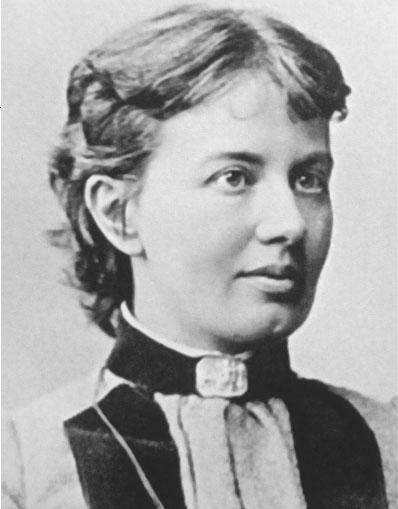
Sofia Kovalevskaya, born on January 15, 1850, in Moscow, Russia, emerged as a pioneering mathematician during a time when women had limited access to higher education. Her early interest in mathematics was sparked in an unconventional way: her family’s home had wallpaper made from her father’s old calculus notes, which she avidly studied.
To pursue her passion for mathematics despite societal constraints, Sofia entered into a marriage of convenience with Vladimir Kovalevsky, allowing her to travel to Germany for further education. She studied under some of the most prominent mathematicians of the time, including Karl Weierstrass at the University of Berlin. Although she couldn’t formally enroll due to her gender, Weierstrass recognized her exceptional talent and gave her private lessons.
In 1874, Sofia earned her doctorate summa cum laude from the University of Göttingen, becoming the first woman to receive a Ph.D. in mathematics. Her dissertation on partial differential equations, specifically the Cauchy-Kovalevskaya theorem, remains a fundamental result in the field.
Despite her qualifications, Kovalevskaya faced significant barriers in securing a position in academia. It wasn’t until 1883 that she was appointed as a lecturer at Stockholm University in Sweden. Two years later, she became the first woman to hold a full professorship in Europe. Her research was prolific and varied, covering topics such as the dynamics of Saturn’s rings, the shape of a rotating solid body, and the theory of elliptic functions.
Kovalevskaya was also a staunch advocate for women in science, playing a pivotal role in promoting gender equality in academia. Her perseverance and achievements opened doors for future generations of women mathematicians. Tragically, her life was cut short when she died of influenza on February 10, 1891, at the age of 41.
Sofia Kovalevskaya’s legacy continues to inspire, showcasing the power of determination and the importance of breaking down barriers in the pursuit of knowledge.
“Sofia Kovalevskaya: A Trailblazing Mathematician’s Unconventional Journey.” 2024. Quora. Accessed December 31. https://qr.ae/pYnDOM.
One of the first women in Europe to hold a university chair, her relationship with mathematics began in a strange but interesting way, as she herself recounts:
“When we moved to the countryside, all the rooms were repainted but since there were so many of them, there wasn’t enough wallpaper for one of the rooms of us children. It was a big undertaking to order more from St. Petersburg and for just one room it was definitely not worth it.
By a happy chance the walls were papered with sheets that were Ostrogradsky’s lectures on differential and integral calculus, purchased by my father in his youth. These sheets, dotted with strange and incomprehensible formulas, soon attracted my attention. I remember how, in my childhood, I spent entire hours in front of that mysterious wall, trying to decipher even a single sentence and to discover the order in which the sheets should follow one another.
By dint of looking at them they became imprinted in my memory, although at the moment of reading they were incomprehensible to me.
When, many years later, at the age of fifteen, I took my first lesson in differential calculus from the famous Petersburg mathematics teacher, Alexander Nikolaevitch Strannoliubsky, he was amazed at the speed with which I grasped and assimilated the notions of terms and derivatives, “just as if I had known them before.” I remember that he expressed himself exactly like that, and in fact, when he began to explain these notions to me, I immediately and vividly remembered that all this was in Ostrogradsky’s pages, so memorable for me, so much so that the concept of limit seemed familiar to me for a long time.”
A short note on the work that was the basis for the award of the doctorate to Kovalevskaya by the University of Göttingen in August 1874. The works dealt with three different topics: partial differential equations, which contains what is now called the Cauchy-Kovalevskaya theorem; the resolution of a certain class of Abelian and elliptic integrals; comments and additions to Lapalce’s work on the shape of Saturn’s rings.
Karl Weierstrass, often called the father of modern analysis, whose figure is closely linked to that of Kovalevskaya since he was one of her greatest supporters, wrote to Lazarus Fuchs:
“In my opinion, there is no doubt that each of these works is sufficient for a thesis.”
“Sofya Kovalevskaya was a mathematician who made notable contributions especially in the field of partial differential equations (the Cauchy-Kovalevskaya theorem is famous).” 2024. Quora. Accessed December 31. https://qr.ae/pYnD94.
 Mathematical Mysteries