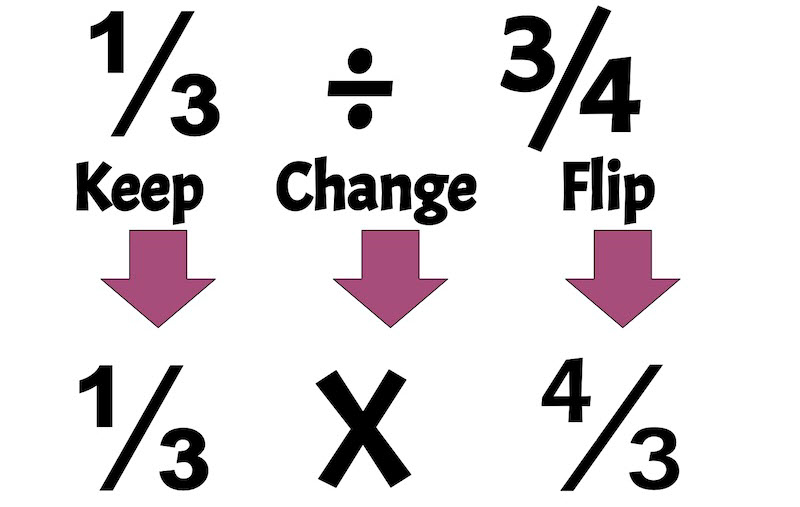
“Keep, Change, Flip” (KCF) is a mnemonic for dividing fractions: Keep the first fraction, Change the division sign to multiplication, and Flip (find the reciprocal of) the second fraction, then multiply as usual. This method simplifies dividing by a fraction into multiplying by its reciprocal, making the problem solvable by standard multiplication.
Example

- Keep: 2/7
- Change: ÷ to ×
- Flip: 3/5 to 5/3
- Multiply

Why Does KCF Work?
Division by a fraction is multiplying by its reciprocal. Here’s how to derive it:
Recall the definition of division:

This holds for any numbers, including fractions.
Reciprocal of a fraction:
The reciprocal of r/s (where r ≠ 0 and s ≠ 0 ) is s/r, because

So

Apply to fractions:
Let the first fraction be p/q and the second be r/s. Then:

This is exactly keep p/q, change ÷ to ×, flip r/s to s/r.
Visual Confirmation
Imagine dividing a pizza as follows: 3/4 of a pizza ÷ 2/5 pizza per slice = how many slices?
Using keep, change flip, we see that it is equivalent to 3/4 of a pizza × 5/2 slices per pizza = 15/8 slices or

How many slices of size two-fifths can be obtained from three-fourths of a pizza? We can see this visually in the fraction chart below, and using the following process.
- Cut the pizza into fourths (green).
- Show two-fifths in relation to three-fourths (yellow).
- Show two-fifths divided into eighths since we are trying to visualize fifteen-eights (using the orange gradient) and subsequently seven-eights (using the black hatching).
- Note that we can get one (of size two-fifths) and seven-eighths (of two-fifths) of a slice from three-fourths of a pizza.
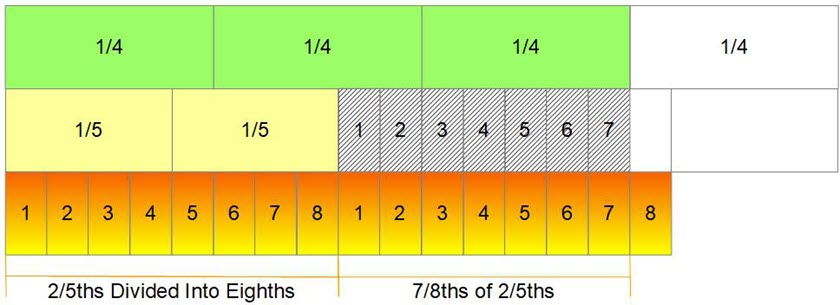
can be obtained from three-fourths of a pizza.
This rule relies on fraction multiplication properties and the multiplicative inverse, making it universal for nonzero fractions.
 Mathematical Mysteries