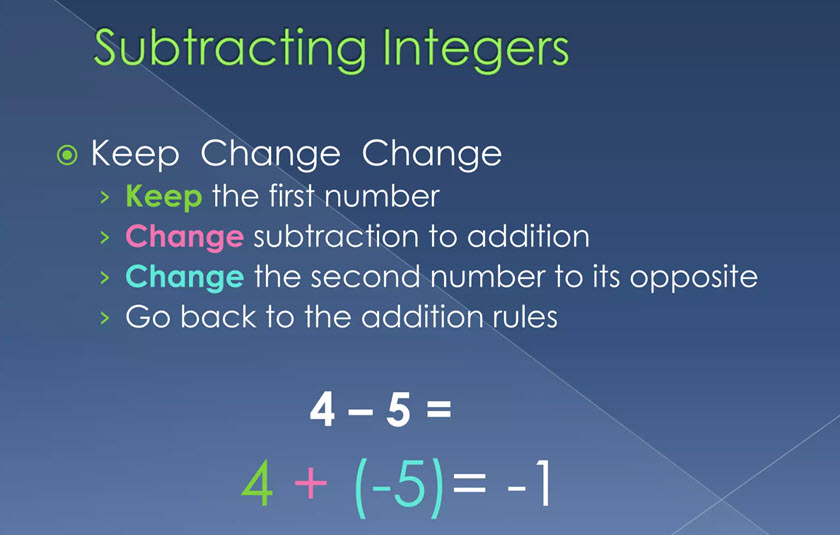
The keep-change-change rule is a method used to subtract integers, where the sign of the second number is changed, and the absolute values of the numbers are then subtracted. This rule helps simplify the process of subtracting integers and ensures consistent and accurate results.
5 Must Know Facts For Your Next Test
- The keep-change-change rule is specifically applicable when subtracting integers, where the signs of the numbers may be different.
- The first step in using the keep-change-change rule is to keep the sign of the first number, the minuend, the same.
- The second step is to change the sign of the second number, the subtrahend, from positive to negative or from negative to positive.
- The third step is to change the absolute values of the numbers and subtract them, following the standard rules of subtraction.
- The keep-change-change rule helps simplify the process of subtracting integers and ensures consistent and accurate results.
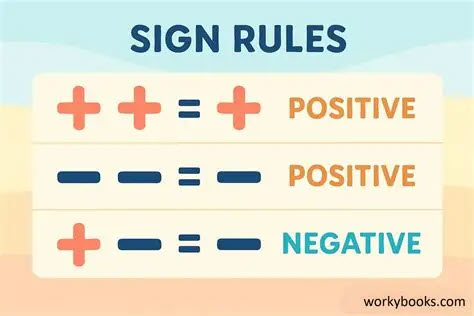
Using the Keep-Change-Change Rule for Subtracting Integers
- Keep the first number (minuend) exactly the same.
- Change the subtraction sign to an addition sign.
- Change the sign of the second number (subtrahend) to its opposite: If it’s positive, make it negative. If it’s negative, make it positive.
- Perform the addition operation with the updated numbers.
Adding & Subtracting Negative Numbers
Adding and subtracting negative numbers might seem tricky at first, but it’s easy when you understand the rules:
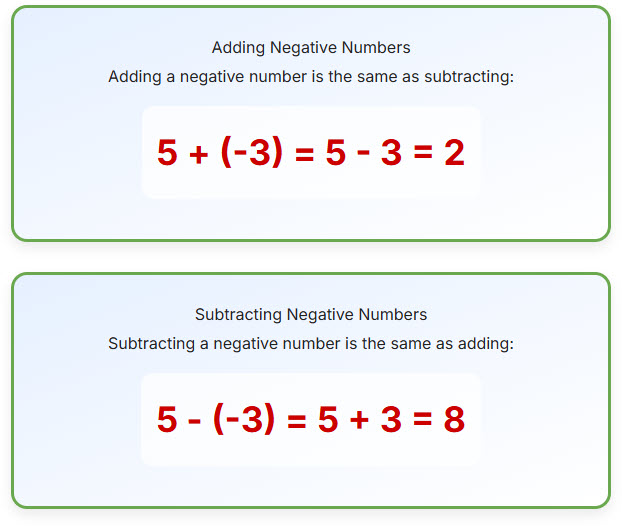
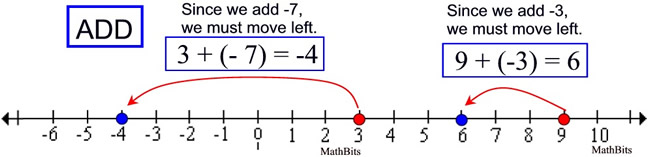
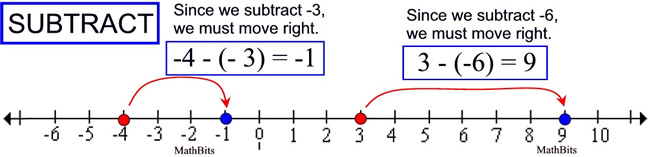
To add and subtract negative numbers using a number line, start at the first number and move right for addition and left for subtraction.
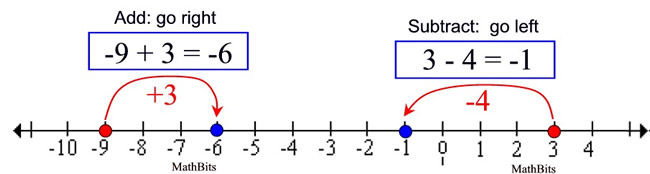
If you are adding a negative number, you will need to move in a negative direction (meaning left instead of right), as the negative indicates the opposite of adding that value.
if you are subtracting a negative number, you will need to move in a positive directions, (meaning right instead of left) as the negative indicates the opposite of subtracting that value.
References
Fiveable. “Keep-Change-Change Rule Definition – Pre-Algebra Key Term.” Accessed January 27, 2026. https://fiveable.me/key-terms/pre-algebra/keep-change-change-rule.
“Negative Numbers.” Workybooks, July 24, 2025. https://www.workybooks.com/resources/math-vocabulary/negative-numbers.
Additional Reading
“Add/Subtract on Number Lines.” MathBitsNotebook(Jr). Accessed January 27, 2026. https://mathbitsnotebook.com/JuniorMath/SignedNumbers/SNAddOnLIne.html.
kmkunz0076. “Signed Numbers.” slideshare. Accessed January 27, 2026. https://www.slideshare.net/slideshow/signed-numbers-29189255/29189255.
The document discusses absolute value and operations involving positive and negative numbers. Absolute value only expresses distance from zero and is always positive. Addition and subtraction of numbers follow specific rules depending on their signs: for addition the signs are kept or changed, for subtraction the operation is changed to addition and the second number’s sign is changed. The same rules for sign of the product apply to both multiplication and division.
Pierce, Rod. “Adding and Subtracting Positive and Negative Numbers.” Math Is Fun. Accessed January 27, 2026. https://www.mathsisfun.com/positive-negative-integers.html.
The featured image on this page is from the Workybooks website.
 Mathematical Mysteries