Contents
- Decimals
- Important Observation
- Addition & Subtraction
- Multiplication
- Division
- Converting Decimal to a Fraction
- Scientific Notation
- Additional Reading
Decimals
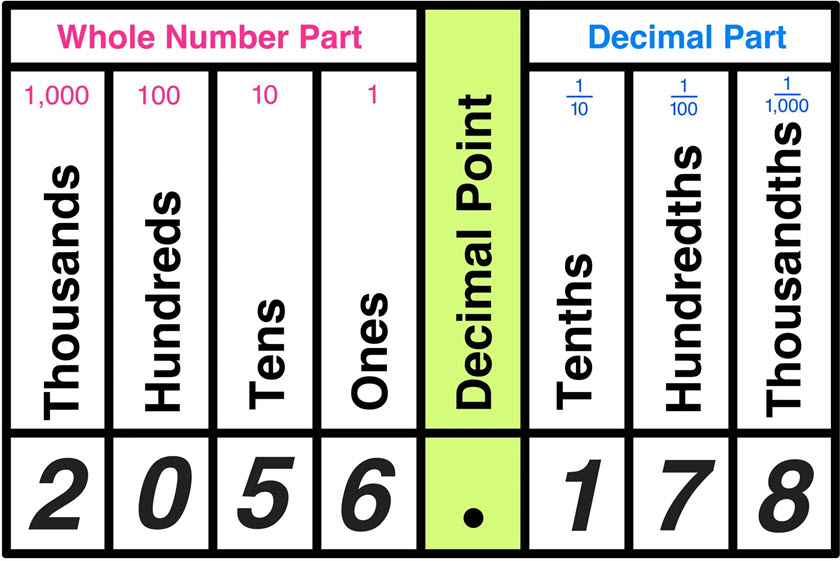
A decimal (or decimal number) in mathematics is a number expressed in the base-10 (denary) positional numeral system, using digits 0–9 and a decimal point (.) to separate the integer part from the fractional part. Decimals enable precise fractional arithmetic in base-10, common in computation and measurement (e.g., 0.01 m = 1 cm).
Structure
- Integer part: Digits to the left of the decimal point
(e.g., 123 in 123.456 and means 100 + 20 + 3). - Fractional part: Digits to the right, representing fractions of 1
(e.g., 456 means ). - Pure integer: No decimal point or fractional digits (e.g., 5 = 5.0).
- Terminating decimal: Finite fractional digits (e.g., 0.75 = ).
- Repeating decimal: Infinite repeating block (e.g., 0.333… = ; notated as 0.3)
Distinctions
- vs. Fraction: Decimals are decimal expansions of rationals (all terminating/repeating); irrationals (e.g., π≈3.14159…, non-repeating) have infinite non-repeating decimals.
- vs. Binary/Hex: Base-10 specific; binary uses base-2 (e.g., 0.1₂ = 0.5₁₀).
- Finite vs. Infinite: All reals have decimal representations, but rationals terminate or repeat.
Important Observation
Adding zeros to the end of the fractional part of a decimal number does not change its value. Similarly, deleting trailing zeros from the end of a decimal number does not change its value.

Addition & Subtraction
Addition
To add decimals, line up the decimal points vertically, add placeholder zeros if needed to align place values, then add from right to left like regular numbers, bringing the decimal point straight down into your answer. This key method ensures you add tenths to tenths, hundredths to hundredths, and so on, making the process straightforward and accurate.
This method works for adding decimals to whole numbers as any whole number has an unwritten decimal point after it (e.g., 7 is 7.0).
Subtraction
To subtract, follow the same method as in addition, i.e., line up the decimal points, then subtract.
Common Mistake
Forgetting to line up the decimal points: This is the most common error; lining them up correctly prevents place value mistakes.
Examples
See the following web pages for examples of adding and subtracting decimals.
Multiplication
To multiply decimals, treat them as whole numbers first, then count the total number of digits after the decimal point in the original numbers and place the decimal point that many places from the right in your answer, adding zeros as placeholders if needed. For example, to multiply 0.3 x 0.4, multiply 3 x 4 to get 12, then count the one decimal place in 0.3 and one in 0.4 (total of two), so your answer is 0.12.
To get another perspective on why we move the decimal, let’s look at this multiplication example using fractions.

Step-by-Step Guide
- Ignore decimals & multiply: Multiply the numbers as if they were whole numbers (e.g., for 1.4 x 0.23, do 14 x 23 = 322).
- Count decimal places: Count how many digits are to the right of the decimal point in each original number (i.e., 1 decimal place for 1.4 and 2 decimal places for 0.23).
- Add them up: Sum the counts from Step 2 to find the total number of decimal places for your answer (i.e., 1 decimal place for 1.4 and 2 decimal places for 0.23 for a total of 3 decimal places).
- Place the decimal: Starting from the right of your whole-number product (i.e., 322. ), move the decimal point to the left the total number of places you counted in Step 3 (i.e., 0.322).
Examples
See the following web pages for examples of multiplying decimals.
Division
Decimal division involves splitting numbers with decimals into equal parts, primarily using long division but requiring special handling of the decimal point: for a decimal divisor, move its decimal to make it a whole number and move the dividend’s decimal the same amount; for a whole number divisor, place the decimal point in the answer directly above its position in the dividend, then follow standard divide, multiply, subtract, bring down, repeat steps.
Dividing by a Whole Number
Example: 12.5 ÷ 2
- Set up: Place the decimal point in the quotient (answer) directly above the decimal point in the dividend (12.5).
- Divide: Solve as you would with whole numbers (How many times does 2 go into 12? 6).
- Multiply: 6 × 2 = 12.
- Subtract: 12 – 12 = 0
- Bring Down: Bring down the next digit (5).
- Repeat: How many times does 2 go into 5? 2 times (2 x 2 = 4). Subtract (5 – 4 = 1). Add a zero to the dividend (12.50) and bring it down (10). 2 goes into 10 five times.
- Answer: 12.5 ÷ 2 = 6.25.
To get another perspective on why we move the decimal, let’s look at this division example using fractions.

Using Keep, Change, Flip to solve the expression, and changing the improper fraction into a decimal.

Dividing by a Decimal
Example: 12.5 ÷ 0.5
- Adjust the Divisor: Move the decimal point in the divisor (0.5) to the right until it becomes a whole number (5). You moved it one place.
- Adjust the Dividend: Move the decimal point in the dividend (12.5) the same number of places to the right (one place), making it 125.
- Set up: Now you’re dividing 125 by 5. Place the decimal in the answer above the new decimal in the dividend (which is at the end of 125).
- Divide: Solve 125 ÷ 5. 5 goes into 12 two times, remainder 2. Bring down the 5 to make 25. 5 goes into 25 five times.
- Answer: 12.5 ÷ 0.5 = 25.
To get another perspective on why we move the decimal, let’s look at this division example using fractions.

Using Keep, Change, Flip to solve the expression, and changing the improper fraction into a decimal or leave as a whole number as needed.

Note
See K-12 – Division for additional information on dividing fractions.
Converting Decimal to a Fraction
To convert a decimal to a fraction, write the decimal over a power of 10 (10, 100, 1000, etc.) corresponding to its place value (tenths, hundredths, thousandths), then simplify the resulting fraction by dividing the numerator and denominator by their greatest common factor. If there’s a whole number, keep it and convert only the decimal part, forming a mixed number.
Steps to Convert a Decimal to a Fraction
- Write as a fraction over 1: Place the decimal number as the numerator and ‘1’ as the denominator (e.g., 0.75 becomes 0.75/1).
- Eliminate the decimal: Count the digits after the decimal point. Multiply the numerator and denominator by 10 for each digit (e.g., for 0.75, multiply by 100 to get 75/100).
- Simplify the fraction: Find the Greatest Common Factor (GCF) of the new numerator and denominator and divide both by it.
- Convert to mixed number (optional): If the fraction is improper (numerator > denominator), convert it to a mixed number.
Examples
- 0.9
- Step 1: 0.9/1
- Step 2: 9/10
- 0.75
- Step 1: 0.75/1
- Step 2: 75/100
- Step 3: Simplify by dividing by 25: 3/4
- 3.36
- Step 1: Keep the whole number 3. Convert the decimal part: 0.36/1
- Step 2: 36/100
- Step 3: Simplify by dividing by 4: 9/25
- Step 4: 3 and 9/25 (a mixed number)
Scientific Notation
Scientific Notation (also called standard form or exponential notation) is a compact way to write very large or very small numbers.
It always follows this exact format:
a × 10b
Where:
- a is a decimal number ≥ 1 and < 10 (written with 1 digit before the decimal point)
- b is an integer (positive, negative, or zero)
| Normal Number | Scientific Notation | Meaning |
|---|---|---|
| 5,600 | 5.6 x 10³ | 5.6 × 1,000 = 5,600 |
| 720,000,000 | 7.2 × 10⁸ | 7.2 × 100,000,000 |
| 0.00034 | 3.4 x 10⁻⁴ | 3.4 ÷ 10,000 |
| 0.000000092 | 9.2 x 10⁻⁸ | 9.2 ÷ 100,000,000 |
| 6,022,000,000,000,000,000,000 | 6.022 × 10²¹ | Avogadro’s number (~particles/mol) |
| 0.00000000000000000016 | 1.6 × 10⁻¹⁹ | Charge of one electron (coulomb) |
| Exponent | Value | Name |
|---|---|---|
| 100 | 1 | |
| 101 | 10 | |
| 103 | 1,000 | kilo |
| 106 | 1,000,000 | mega |
| 109 | 1,000,000,000 | giga |
| 1012 | 1,000,000,000,000 | tera |
| 10-3 | 0.001 | milli |
| 10-6 | 0.000001 | micro |
| 10-9 | 0.000000001 | nano |
| 10-12 | 0.000000000001 | pico |
Additional Reading
“3.2: Adding and Subtracting Decimals.” LibreTexts, August 15, 2023. https://math.libretexts.org/Courses/Western_Technical_College/PrePALS_PreAlgebra/03%3A_Decimals/3.02%3A_Adding_and_Subtracting_Decimals.
“3.3: Multiplying Decimals.” LibreTexts, August 15, 2023. https://math.libretexts.org/Courses/Western_Technical_College/PrePALS_PreAlgebra/03%3A_Decimals/3.03%3A_Multiplying_Decimals.
“Decimal.” Wikipedia, December 29, 2025. https://en.wikipedia.org/wiki/Decimal.
“How to Convert Decimals to Fractions.” Dummies, July 8, 2025. https://www.dummies.com/article/academics-the-arts/math/algebra/how-to-convert-decimals-to-fractions-194339/.
“How to Multiply Decimals.” Dummies, July 8, 2025. https://www.dummies.com/article/academics-the-arts/math/pre-algebra/how-to-multiply-decimals-149581/.
Persico, Anthony. “Where Is the Hundredths Place Value in Math? — Mashup Math.” Mashup Math, December 11, 2022. https://www.mashupmath.com/blog/hundredths-place-value-hundredths-chart.
Pierce, Rod. “Adding Decimals.” Math Is Fun. Accessed January 21, 2026. https://www.mathsisfun.com/adding-decimals.html.
Pierce, Rod. “Convert Decimals to Fractions.” Math Is Fun. Accessed January 21, 2026. https://www.mathsisfun.com/converting-decimals-fractions.html.
Pierce, Rod. “Multiplying Decimals.” Math Is Fun. Accessed January 21, 2026. https://www.mathsisfun.com/multiplying-decimals.html.
Pierce, Rod. “Subtracting Decimals.” Math Is Fun. Accessed January 21, 2026. https://www.mathsisfun.com/subtracting-decimals.html.
Stapel, Elizabeth. “Converting Decimals to Fractions and Percents.” Purplemath. Accessed January 21, 2026. https://www.purplemath.com/modules/percents2.htm.
Stapel, Elizabeth. “Why Does Scientific Notation Exist? How’s It Work?” Purplemath. Accessed January 21, 2026. https://www.purplemath.com/modules/exponent3.htm.
The featured image on this page is from the mashupmath website.
 Mathematical Mysteries