Contents
2012 – THE MAYA CALENDAR AND THE “END OF TIME”
Background
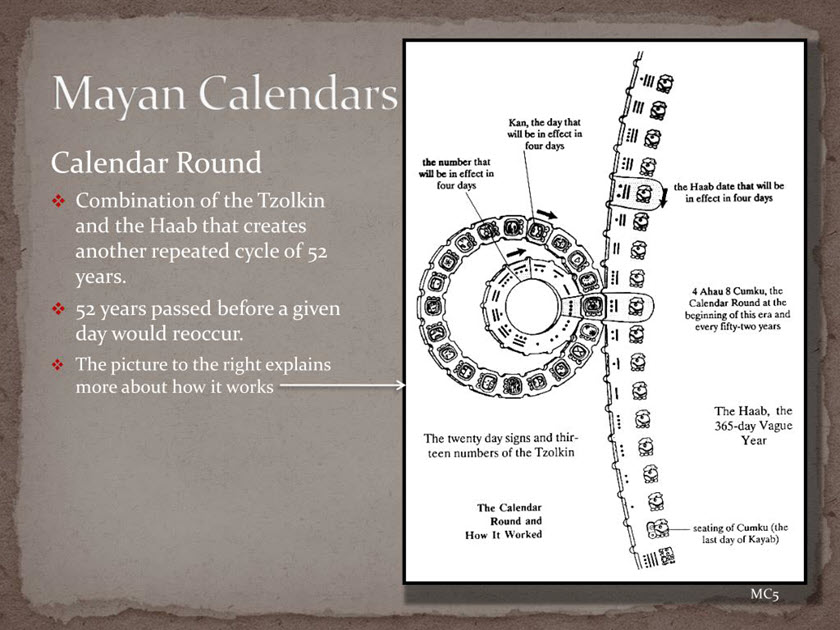
The Maya civilization, which flourished in southern Mexico, Guatemala, and Belize from about 2000 BC to 1000 AD, had a system of three calendars (fully described for the cover picture of Astronomical Calendar 2010):
- The Long Count, or numbering of days from (probably) 3114 BC Sep. 7: 20 kin (days) make a winal; 18 winal, a tun (360 days); 20 tun, a katun; 20 katun, a baktun (144,000 days, about 394 years). Even larger units were not actually used in the expression of dates: 20 baktun make a piktun (2,880,000 days); 20 piktun, a kalabtun; 20 kalabtun, a kinchiltun; 20 kinchiltun, an alautun (23,040,000,000 days, or around 63 million years).
- Haab, in which a 365-day year was divided into 18 20-day units with names (Pop, Wo, Zip, Zotz, Tzek, Xul, Yaxkin, Mol, Chen, Yax, Zak, Keh, Mak, Kankin, Muwan, Pax, Kayab, Kunku) and a 5-day 19th (Wayeb).
- Tzolkin, in which each day had one of 13 numbers, and also one of 20 names (Imix, Ik, Akbal, Kan, Chikchan, Kimi, Manik, Lamat, Muluk, Ok, Chuwen, Eb, Ben, Ix, Men, Kib, Kaban, Etznab, Kawak, Ahau), so that any one combination, such as 1 Imix, came around after a cycle of 260 days.
Some of these numberings started not with 1 but with zero; thus katun 19 is really the 20th in its baktun, and is followed by katun 0, which is the first in the next baktun.
The Scare
Chances are you have heard that the Maya predicted the end of the world on December 21, 2012. This was the day when the Maya Long Count calendar cycle came to completion. You may have also heard that the world was predicted to be destroyed by an earthly or cosmic catastrophe. We know these predictions didn’t come true – but were any based on fact, or total fiction?
December 21, 2012 marked the end of an important cycle in the Maya Long Count calendar. This cycle is composed of 13 periods, called baktun, of 144,000 days each. When the 13 baktuns are grouped together, they form a Great Cycle that lasts approximately 5,125 years. The Maya used a sophisticated system called the Long Count to track these massive stretches of time.
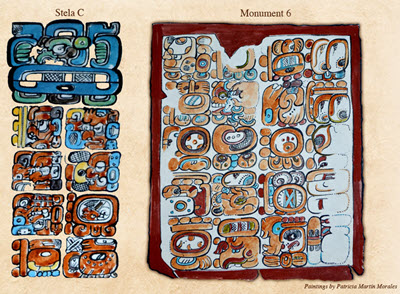
- This 13-baktun cycle began on the Long Count calendar date 13.0.0.0.0 4 Ajaw 8 Kumk’u, and spans 5,125.366 solar years. Stela C (left) records this date, considered by the Maya to be the creation date of the current or 4th era.
- The monument is at the archaeological site of Quiriguá, Guatemala.
- This creation date corresponds to August 11, 3114 BCE. Monument 6 (right), from the archaeological site of Tortuguero in Tabasco, México, records the only known Maya inscription of the end date of the 13-baktun cycle.
- This end date, 13.0.0.0.0 4 Ajaw 3 Kank’in, corresponds to December 21, 2012.
- If you want to find out what any date in our time would be in the Maya calendar, simply type in your chosen date and click the convert button using the Date Conversion Calculator.
There is no evidence in these inscriptions, or in any other record, that the ancient Maya thought that the Long Count calendar would imply some kind of catastrophic “end.” These predictions were unfounded and are not shared by the Maya people.
What does this mean? The Long Count rolls into “a string of zeros, like the odometer turning over on your car,” as E.C. Krupp put it in his amusing article about “The Great 2012 Scare,” for the November 2009 issue of Sky & Telescope. This is the end of one baktun and the beginning of another; so its component katuns, tuns, winals and kins all start again at 0. According to some authorities, the first baktun was 0, and the baktun now ending is 12; according to others it is 13. Either way, it is the 13th since the start-date of the Long Count.
References
“2012 Phenomenon.” Wikipedia, February 5, 2026. https://en.wikipedia.org/wiki/2012_phenomenon.
Davies, Diane. “Maya Mathematics.” April 6, 2020. https://www.mayaarchaeologist.co.uk/public-resources/maya-world/maya-mathematics-resources/.
Davies, Diane. “The Maya Calendar Explained.” December 31, 2016. https://www.mayaarchaeologist.co.uk/public-resources/maya-world/maya-calendar-system/.
Grandon, Brittny, and Betty Morfin, Vincent Trang and Jackilynn Sterba. “Mayan Science.” SlideServe. Accessed February 7, 2026. https://www.slideserve.com/kolton/mayan-science.
Johnson, Ryan, and Cristen Conger. “How the Mayan Calendar Works.” HowStuffWorks, December 27, 2007. https://people.howstuffworks.com/mayan-calendar.htm.
Living Maya Time. “Maya Calendar Converter.” Accessed February 7, 2026. https://maya.nmai.si.edu/calendar/maya-calendar-converter.
Living Maya Time. “The Meaning of 2012.” Accessed February 7, 2026. https://maya.nmai.si.edu/2012-resetting-count/meaning-of-2012.
Maya Decipherment. “Bak’tuns and More Bak’tuns.” December 19, 2012. https://mayadecipherment.com/2012/12/19/baktuns-and-more-baktuns/.
Universal Workshop. “THE MAYA CALENDAR AND THE ‘END OF TIME.’” September 22, 2017. https://www.universalworkshop.com/maya-calendar-end-time/.
Notes
4th Era: In Maya mythology, we are living in the Fourth Creation of the Universe, which began on August 11, 3114 BCE.
Baktun: One of the cycles of the Maya Long Count calendar containing 144,000 days.
Creation Date: The creation date of the Maya Long Count calendar, corresponding to 11 August 3114 BCE in the Gregorian calendar.
Great Cycle: Each great cycle lasted 5128 years and it repeated indefinitely. The first great cycle was to end on 21 December 2012. This led to the popular idea that the Maya prophesied the world was to end on that date. However, this is completely a modern invention, time was not lineal for the Maya, but cyclical and ever repeating.
- The Building Blocks of the “Great Cycle”
- The Long Count is based on a “vigesimal” (base-20) system. Each unit is a multiple of the one before it:
- K’in: 1 day.
- Winal: 20 days.
- Tun: 360 days (approx. 1 solar year).
- K’atun: 7,200 days (approx. 20 years).
- B’ak’tun: 144,000 days (approx. 394 years).
- The “Great Cycle” (13 B’ak’tuns)
- For the Maya, the number 13 was sacred. They believed the current world began on August 11, 3114 B.C., marking the start of a 13-b’ak’tun era.
- Total Days: 1,872,000 days (13 x 144,000).
- Total Years: Roughly 5,125.36 solar years.
- The Big Reset: This specific era concluded on December 21, 2012.
- Cultural Significance
- The completion of a b’ak’tun or a Great Cycle wasn’t a “doomsday” event. Instead, it was viewed as:
- A “New Year’s” Reset: Like an odometer flipping from 99,999 back to 00,000, the calendar simply restarted a new 5,125-year period.
- A Time of Transformation
- Many modern Maya and scholars view these transitions as the beginning of a new era of spiritual or physical transformation rather than destruction. Cosmic Renewal: According to the Popol Vuh (the Mayan creation story), we are currently living in the “Fourth World,” and these cycles represent the ongoing relationship between humanity, the gods, and the cosmos.
Long Count: One of the calendars of the ancient Maya, spanning cycles of 5,215 years.
Solar Year: A solar, or tropical year, is the length of time that the Sun takes to return to the same position in the cycle of seasons, as seen from Earth. The mean solar year is 365.242 days.
Stela: A monument shaped like a column, usually monolithic, inscribed with a commemorative, funerary, or ceremonial function.
Videos
 Mathematical Mysteries