Contents
1986 – No Calculators
In April 1986, a committed group of math teachers led by textbook author John Saxon gathered outside the National Council of Teachers of Mathematics (NCTM) conference in Washington, D.C., to protest a new policy that promoted the use of calculators in all grades, even for young children.
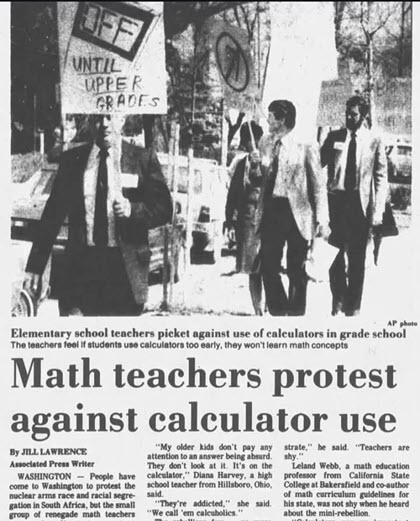
Some held signs like ‘TURN OFF UNTIL UPPER GRADES.’ They argued that students needed to master basic arithmetic and mental math skills by hand first before relying on machines, warning that premature use could turn kids into “calcuholics” who lose the ability to think deeply about numbers and concepts.
Other protesters carried signs with slogans like “The Button’s Nothin’ ’Til the Brain’s Trained,” fearing that machines would act as a crutch and prevent students from learning basic arithmetic.
These protesters feared that “premature” dependence on technology would weaken students’ basic arithmetic skills and result in a generation unable to perform simple mental math.
While these teachers worried about students losing their mental math skills, the NCTM argued that calculators could actually help kids concentrate on solving more challenging problems instead of getting stuck on lengthy calculations.
This historical standoff illustrates how people often fear new tools before they become a normal part of life. The 1986 protest reminds us that although technology is a powerful tool, mastering the fundamentals still plays a crucial role in education.
References
blowingfact. “In 1986, Math Teachers Protested Against Calculators.” Instagram. Accessed February 6, 2026. https://www.instagram.com/p/DUGq-Iijn4C/?igsh=ZHM1M2YwZXNmaXpq.
Mechanical Engineering World. “In 1986, Math Teachers Protested Against Calculators.” Facebook. Accessed February 6, 2026. https://www.facebook.com/mech.eng.world/posts/in-1986-a-group-of-concerned-math-teachers-held-a-notable-protest-that-still-ech/1347298540762848/.
penduproduction. “When Math Teachers Protest Against Calculators in 1986.” Instagram. Accessed February 6, 2026. https://www.instagram.com/p/DUSWDidCHUE/?igsh=MjdsazA4NWRpZ3d5.
Rowe, Jonathan. “The Great Calculator Debate. Educators Disagree over Their Place in the Classroom.” The Christian Science Monitor, n.d. Accessed February 6, 2026. https://www.csmonitor.com/1986/0509/dcalc-f.html.
Notes
Calcuholics: Students’ dependence on calculators can weaken their basic problem-solving skills by reducing their mental calculation abilities and number sense. When learners rely heavily on calculators for even simple arithmetic, they often lose confidence in manual computation and fail to develop a strong understanding of mathematical concepts. This dependence can make it harder for them to analyze problems, develop strategies, and verify answers without technology, ultimately limiting their ability to think critically and solve problems independently.
The featured image on this page is from the adhischools.com website.
 Mathematical Mysteries