Contents
Causal Relationships
Causal relationships describe a situation where one event or variable directly causes or influences another event or variable. In other words, there is a direct, deterministic link between the two. If the cause occurs, the effect will follow. Causal relationships are often expressed using language like “if-then” statements, where the cause is the condition and the effect is the consequence.
if (testscore >= 90) {
   grade = 'A';
} else if (testscore >= 80) {
   grade = 'B';
} else if (testscore >= 70) {
   grade = 'C';
} else if (testscore >= 60) {
   grade = 'D';
} else {
   grade = 'F';
}
In mathematics, a causal relationship refers to a situation where one quantity or variable directly influences or causes a change in another quantity or variable. This concept is often used in the context of functions or equations to describe how changes in one variable result in changes in another variable.
For example, in a simple linear equation y = mx + b, where y is the dependent variable, x is the independent variable, m is the slope, and b is the y-intercept, there is a causal relationship between x and y. Changes in the value of x directly influence the value of y according to the equation.
Causal relationships are important in many areas of mathematics, such as differential equations, where the rate of change of a variable is directly related to the value of another variable. Understanding causal relationships can help mathematicians and scientists model and predict how different quantities interact and change over time.
Conditional Relationships
Conditional relationships, on the other hand, describe a situation where the occurrence of one event or variable is dependent on the occurrence of another event or variable, but there is not necessarily a direct causal link between them. In other words, the relationship is probabilistic or statistical, rather than deterministic.
Conditional relationships are often expressed using language like “if-then” statements, similar to causal relationships, but the connection between the condition and the outcome is not as direct or certain. The outcome may or may not occur, depending on the probability or likelihood of the condition being met.
For example, the statement “If it’s cloudy, it’s likely to rain” describes a conditional relationship. The cloudiness (the condition) increases the probability of rain (the outcome), but it does not guarantee it. The relationship is probabilistic, not deterministic.
Boolean Logic
Boolean logic is a conditional relationship.
Boolean logic deals with the manipulation of logical values, which are typically represented as either true (1) or false (0). The relationships in Boolean logic are based on conditional statements, not causal relationships.
In Boolean logic, the basic operators are:
- AND (conjunction): The output is true only if both inputs are true.
- OR (disjunction): The output is true if at least one of the inputs is true.
- NOT (negation): The output is the opposite of the input (true becomes false, and false becomes true).
These Boolean operators describe conditional relationships, where the output is dependent on the input values, but there is no direct causal link between them. The relationship is based on the rules of logic, not on a direct cause-and-effect mechanism.
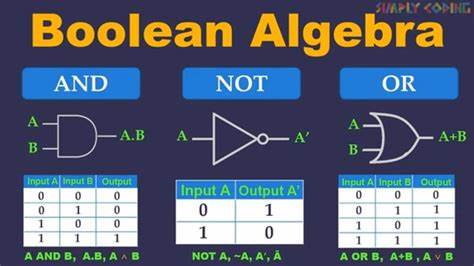
For example, the statement “If A is true and B is true, then C is true” is a conditional relationship in Boolean logic, not a causal relationship. The truth value of C is dependent on the truth values of A and B, but C does not cause A or B to be true.
Boolean logic is a mathematical system that deals with the manipulation of logical values and the relationships between them, which are conditional in nature, not causal.
Correlation
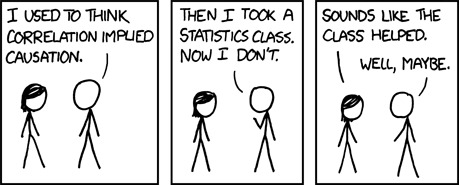
Causation and correlation are not the same thing in mathematics and statistics.
Correlation refers to a statistical relationship between two variables, where changes in one variable are associated with changes in another variable. Correlation does not necessarily imply that one variable causes the other. Correlation can be positive (the variables move in the same direction) or negative (the variables move in opposite directions).
Causation, on the other hand, refers to a direct, causal relationship between two variables, where changes in one variable directly cause changes in the other variable. Causation implies that one variable is the reason or cause for the changes observed in the other variable.
In other words:
- Correlation means the variables are related, but it doesn’t necessarily mean one causes the other.
- Causation means one variable directly causes changes in the other variable.
To establish causation, researchers typically need to conduct controlled experiments or use advanced statistical techniques to isolate the causal relationship between variables and rule out other potential confounding factors.
Correlation and causation are related but distinct concepts in mathematics and statistics. Correlation indicates a relationship exists, while causation indicates one variable directly causes changes in the other.
When does correlation imply causation?
Correlation does not automatically imply causation. There are some specific conditions where correlation may suggest causation, but additional evidence is usually required to establish a causal relationship:
- Temporal precedence: The cause must occur before the effect in time. If changes in one variable precede changes in the other variable, it provides some evidence of a causal relationship.
- Covariation: There needs to be a systematic covariation (correlated variation) between the cause and the effect. As the cause changes, the effect should also change in a consistent way.
- Ruling out alternative explanations: Other potential factors that could be causing the observed relationship need to be controlled for or ruled out through further investigation.
- Plausible mechanism: There should be a plausible theoretical explanation or mechanism that can account for how the cause influences the effect.
Even when these conditions are met, correlation alone is generally not sufficient to conclude causation. Additional experimental evidence or advanced statistical techniques (e.g., regression analysis, instrumental variables, randomized controlled trials) are typically required to more confidently establish a causal relationship between two variables.
It’s important to remember that correlation does not necessarily imply causation, and care should be taken when interpreting the relationship between correlated variables. Correlation may suggest an area for further investigation, but it does not automatically indicate that one variable is the cause of the other.
Summary
The key difference between causal relationships and conditional relationships in mathematics is the nature of the connection between the variables or events. Causal relationships involve a direct, deterministic link, while conditional relationships involve a probabilistic or statistical connection.
References
“Fast, Helpful AI Chat.” 2024. Poe. Assistant. Accessed June 15. https://poe.com/.

I used AI bots in this article to capture ideas that I could not develop on my own without more extensive research. I recall back in the 1990s attending presentations at conferences where the presenter was using crawler bots to gather information for their research. I am still experimenting with AI bots, and will continue to use them as needed to present ideas and concepts more clearly to the reader.
Source of information unless otherwise indicated.
Additional Reading
“2.3 If-Then Statements”. 2024. CK-12. Accessed July 8. https://flexbooks.ck12.org/cbook/ck-12-basic-geometry-concepts/section/2.3/primary/lesson/if-then-statements-bsc-geom/.
A conditional statement (also called an if-then statement ) is a statement with a hypothesis followed by a conclusion . The hypothesis is the first, or “if,” part of conditional statement. The conclusion is the second, or “then,” part of a conditional statement. The conclusion is the result of a hypothesis.
“3.2: Causal Relationships.” 2021. Social Sci LibreTexts. Libretexts. May 11. https://socialsci.libretexts.org/Courses/Arapahoe_Community_College/ESA_420%3A_Research_and_Design_for_Emergency_Services/03%3A_Design_and_Causality/3.02%3A_Causal_relationships.
Most social scientific studies attempt to provide some kind of causal explanation. A study on an intervention to prevent child abuse is trying to draw a connection between the intervention and changes in child abuse. Causality refers to the idea that one event, behavior, or belief will result in the occurrence of another, subsequent event, behavior, or belief. In other words, it is about cause and effect. It seems simple, but you may be surprised to learn there is more than one way to explain how one thing causes another. How can that be? How could there be many ways to understand causality?
Emmert-Streib, Frank, and Matthias Dehmer. 2023. Frontiers for Young Minds 11 (December). doi:10.3389/frym.2023.1155100. “Causality: Using Math to Understand the Science of Cause and Effect”. https://kids.frontiersin.org/articles/10.3389/frym.2023.1155100.
Some people say mathematics is the most important subject in science because it is the language of nature. In this article, we provide examples for this by explaining causality. Causality is an important concept because it influences essentially all areas of science and society. In simple terms, causality is the principle that examines the link between a “cause” and an “effect”. This allows us to study important practical questions. For instance, in medicine, biology or law, one can ask “What medication can be used to treat this disease?” “What protein activates a certain gene?” or “What criminal act caused the harm?” To answer these and similar questions, methods from probability, statistics, and graph theory are needed to quantify the meaning of causality. In this article, we provide an overview of this fascinating topic.
“Logic, Symbolic Logic & Boolean Algebra.” 2024. Mathematical Mysteries. April 3. https://mathematicalmysteries.org/logic-symbolic-logic-boolean-algebra/.
“Sets & Set Theory.” 2023. Mathematical Mysteries. September 15. https://mathematicalmysteries.org/sets-set-theory/.
“Types of Correlation”. 2024. Numeracy, Maths and Statistics – Academic Skills Kit. Accessed July 8. https://www.ncl.ac.uk/webtemplate/ask-assets/external/maths-resources/statistics/regression-and-correlation/types-of-correlation.html.
Definitions
Correlated Variation
Correlated variation refers to the idea that two or more variables tend to vary or change together in a systematic way. In other words, when two variables are correlated, changes in one variable are associated with changes in the other variable. This means that the variables tend to move in the same direction (positive correlation) or in opposite directions (negative correlation).
Some key points about correlated variation:
- Strength of correlation:
- The degree of correlated variation can range from a weak or low correlation to a strong correlation, depending on the magnitude of the relationship.
- Direction of correlation:
- Positive correlation means the variables move in the same direction.
- Negative correlation means the variables move in opposite directions.
- Causal vs. non-causal:
- Correlated variation does not necessarily imply that one variable causes the other. It only indicates a statistical relationship between the variables.
- Potential explanations:
- Correlated variation can occur due to a causal relationship, a common cause, or some other underlying connection between the variables.
- Importance in research and analysis:
- Identifying and understanding correlated variation is important in fields like statistics, data analysis, and scientific research, as it can provide insights into relationships between different phenomena.
Correlated variation refers to the phenomenon where two or more variables demonstrate a systematic, associated change or movement, either in the same direction (positive correlation) or in opposite directions (negative correlation). This relationship can be further investigated to understand the nature and potential causes of the correlated variation.
Correlation
In statistics, correlation is a statistical measure that describes the relationship between two variables, or bivariate data, and the degree to which they are linearly related. It can be positive or negative, strong or weak, and symmetrical. Correlation is often used to describe simple relationships without making a statement about cause and effect.
In mathematics, correlation describes if a relationship exists between two variables, how strong this relationship is, and whether a change in one variable induces a positive or negative change in another.
 Mathematical Mysteries