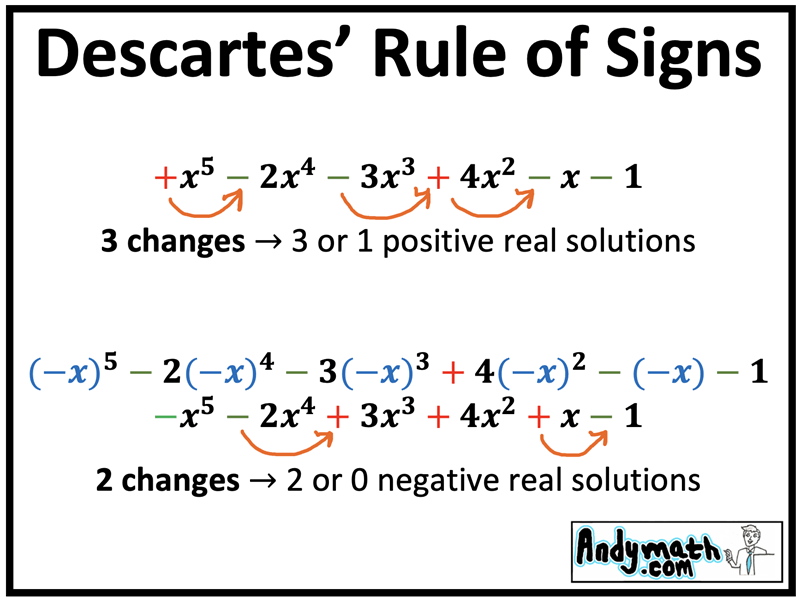
The purpose of the Descartes’ Rule of Signs is to provide an insight on how many real roots (zeros) a polynomial P(x) may have.
Descartes’ Rule of Signs is a criterion which gives an upper bound on the number of positive or negative real roots of a polynomial with real coefficients. The bound is based on the number of sign changes in the sequence of coefficients of the polynomial. [3]
Descartes’ Rule of Signs counts the changes of sign (that is, “plus” to “minus”, and vice versa) between consecutive pairs of terms in a polynomial named f (x). [1]
- For f (x), the number of sign changes between consecutive pairs of terms gives you the maximum number of positive real-number roots (zeroes, solutions) of the polynomial.
- For f (−x), the number of sign changes between consecutive pairs of terms give you the maximum number of negative real-number roots (zeroes, solutions) of the polynomial.
- Because the polynomial may have quadratic factors which have only complex-number solutions, the counts for the numbers of solutions are decremented (that is, reduced) by 2, 4, etc., until you reach zero or a negative number. (See Notes 10 and 11.)
Descartes Rule of Signs Chart
Descartes’ Rule of Signs does not provide an exact number of real roots; it only provides the number of positive and negative real roots that could exist. As a result, we can create a chart that shows a possible amount of positive, real, and imaginary roots. [7]
Notes
- Before using the Rule of Signs the polynomial must have a constant term (like “+2” or “−5”). If it doesn’t, then just factor out x until it does. [2]
- The number of positive, or negative, roots equals the number of sign changes, or a value less than that by some multiple of 2. [2] [6]
- If the maximum number of positive roots was 6, then there could be 6, or 4 or 2 or 0 positive roots.
- If the maximum number of positive roots was 5, then there could be 5, or 3 or 1 positive roots.
- A polynomial will have exactly as many roots as its degree (the degree is the highest exponent of the polynomial) according to the Fundamental Theorem of Algebra. [2]
- There can be only imaginary roots of a polynomial, if the discriminant < 0. [4]
- When applying Descartes’ Rule of Signs, before counting the sign changes (of either f(x) or f(-x)), first arrange the polynomial in the descending order of exponents of the variable. [5]
- Avoid writing terms that have a coefficient to be 0. For example DO NOT write x2 – 1 as x2 + 0x – 1 while counting the sign changes. [5]
- Descartes’ rule of signs cannot give the actual number of positive or real roots (except in the case of 0 or 1). [5]
- If the number of sign changes of ( f(x) or f(-x) ) is 0 or 1 then that number itself is the actual number of real roots as it cannot be decreased by an even number anymore. [5]
- While finding f(-x), only the signs of terms of f(x) with odd exponents will change. [5]
- Note that the number of roots of a polynomial function (considering the roots with multiplicities to be independent roots) is equal to the degree of the polynomial. Thus, the number of complex roots can be obtained by subtracting the sum of positive and real roots from the degree of the polynomial. [5]
Minimum number of non-real roots = degree of the polynomial – (max number of positive roots + max number of negative roots). - Having complex roots will reduce the number of positive roots by 2 (or by 4, or 6, …, etc.), in other words by an even number because complex roots always come in pairs. [2]
Examples
First, arrange the polynomial terms in descending order by exponent (see Note 6). The polynomial’s number of positive roots is either equal to or less than the number of sign differences between consecutive nonzero coefficients by an even number.
Example #1
f(x) = 2x5 + 3x4 + 4x3 + 5x2 + x + 6
The coefficients are 2, 3, 4, 5, 1, 6 ∴ 0 changes occur, and we have 0 positive real roots.
Consider −x instead of x if you wish to determine the negative real roots quantity:
f(-x) = −2x5 + 3x4 − 4x3 + 5x2 −x + 6
The coefficients are −2, 3, −4, 5, −1, 6 ∴ 5 changes occur, and we have 5 or 3 or 1 negative real roots.
| Positive | Negative | Imaginary | Total |
|---|---|---|---|
| 0 | 5 | 0 ( = 5 – (0 + 5) ) | 5 ( = 0 + 5 + 0 ) |
| 0 | 3 | 2 ( = 5 – (0 + 3) ) | 5 ( = 0 + 3 + 2 ) |
| 0 | 1 | 4 ( = 5 – (0 + 1)) | 5 ( = 0 + 1 + 4 ) |
Using WolframAlpha|PRO, calculate the real roots and the imaginary roots (see Note 10):
- (-1.58421, 0)
- (-0.413553, 1.30717i)
- (-0.413553, -1.30717i)
- (0.455656, 0.894325i)
- (0.455656, -0.894325i)
Using Desmos, graph f(x).

Example #2
f(x) = 6x4 – x3 + 4x2 – x – 2
The coefficients are 6, -1, 4, -1, -2 ∴ 3 changes occur, and we have 3 or 1 positive real roots.
Consider −x instead of x if you wish to determine the negative real roots quantity:
f(-x) = 6x4 + x3 + 4x2 + x – 2
The coefficients are 6, 1, 4, 1, -2 ∴ 1 change occur, and we have exactly 1 negative real root.
| Positive | Negative | Imaginary | Total |
|---|---|---|---|
| 3 | 1 | 0 ( = 4 – (3 + 1) ) | 4 ( = 3 + 1 + 0 ) |
| 1 | 1 | 2 ( = 4 – (1 + 1) ) | 4 ( = 1 + 1 + 2 ) |
Using WolframAlpha|PRO, calculate the real roots and the imaginary roots (see Note 10):
- (-1/2, 0)
- (2/3, 0)
- (-i, 0)
- (i, 0)
Using Desmos, graph f(x).

References
[1] Stapel, Elizabeth. 2023. “What Is Descartes’ Rule Of Signs? How Does It Work?”. Purplemath. https://www.purplemath.com/modules/drofsign.htm.
[2] “Polynomials: The Rule of Signs”. 2023. mathsisfun.com. https://www.mathsisfun.com/algebra/polynomials-rule-signs.html.
[3] “Descartes’ Rule of Signs | Brilliant Math & Science Wiki”. 2023. brilliant.org. https://brilliant.org/wiki/descartes-rule-of-signs/#applications-of-descartes-rule-of-signs.
[4] “Descartes’ Rule of Signs Calculator”. 2023. calculator-online.net. https://calculator-online.net/descartes-rule-of-signs-calculator/.
[5] “Descartes Rule of Signs”. 2023. CUEMATH. https://www.cuemath.com/algebra/descartes-rule-of-signs/.
[6] Some of the roots may be generated by the Quadratic Formula, and these pairs of roots may be complex and thus not graphable as x-intercepts. Because of this possibility, I have to count down by 2’s to find the complete list of the *possible* number of zeroes. That is, while there may be as many as four real zeroes, there might in fact be only two positive real zeroes, or there might in fact be zero zeroes (that is, there might be no positive roots at all). [1]
[7] “Descartes Rule of Signs: Definition, State, Proof, Chart, Table, Uses, Applications and Solved Example”. 2023. testbook.com. https://testbook.com/maths/descartes-rules-of-signs.
Additional Reading
“Descartes’ Rule of Signs”. 2023. andymath.com. https://andymath.com/descartes-rule-of-signs/.
“Descartes’ Rule of Signs – Wikipedia”. 2023. en.wikipedia.org. https://en.wikipedia.org/wiki/Descartes%27_rule_of_signs.
“How to Use Descartes’ Rule of Signs (With Examples)”. 2022. Owlcation. https://owlcation.com/stem/Descartes-Rule-of-Signs.
Stapel, Elizabeth. 2023. “Descartes’ Rule of Signs Helps Solve Polynomials”. Purplemath. https://www.purplemath.com/modules/synthtrk.htm.
Stapel, Elizabeth. 2023. “Factoring Polynomials: How-To | Purplemath”. Purplemath. https://www.purplemath.com/modules/solvpoly2.htm.
Stapel, Elizabeth. 2023. “Solving Polynomials: How-To | Purplemath”. Purplemath. https://www.purplemath.com/modules/solvpoly.htm.
Videos
This precalculus video tutorial provides a basic introduction into Descartes’ Rule of Signs which determines the nature and number of the solutions to a polynomial equation. The number of sign changes in f(x) is related to the number of positive real zeros and the number of sign changes in f(-x) is related to the number of negative real zeros. The imaginary solutions is the difference between the degree of the polynomial and the sum of real zeros including positive real zeros and negative real zeros. This video explains the results of Descartes’ Rule of Signs using a table. This video explains how to identify the exact number of positive and negative real zeros by actually finding all the zeros of the polynomial function by factoring by grouping and by factoring using synthetic division. This video contains plenty of examples and practice problems.
⭐ I suggest that you read the entire reference. Other references can be read in their entirety but I leave that up to you.
The featured image on this page is from the Andymath.com website.
 Mathematical Mysteries