Definition
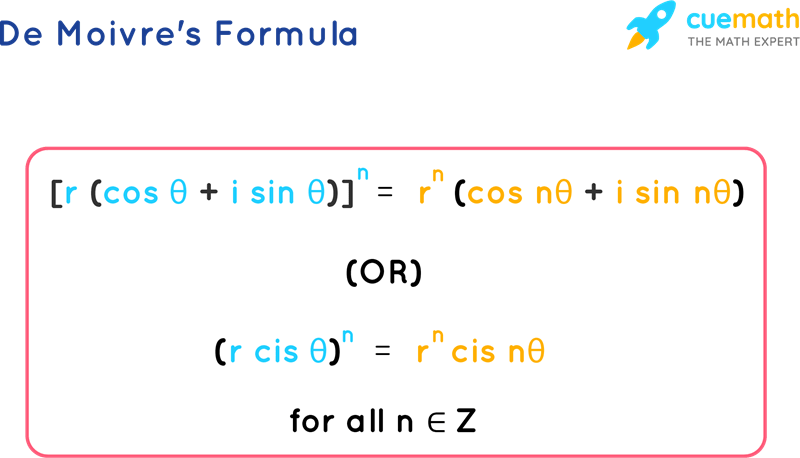
De Moivre’s formula (or) De Moivre’s theorem is related to complex numbers. We can expand the power of a complex number just like how we expand the power of any binomial. But De Moivre’s formula simplifies the process of finding the power of a complex number much simple. To apply De Moivre’s formula, the complex number first needs to be converted into polar form. [1]
This theorem holds utmost importance in the universe of complex numbers as it helps connect the field of trigonometry to the intricacies of complex numerals. It also helps obtain relationships between various trigonometric functions of different angles. It is so-called because this theorem was propounded by one of the most notable mathematicians in history, De Moivre, who contributed a lot to the fields of probability, algebra, etc. The theorem is also referred to as De Moivre’s Formula or De Moivre’s Identity. [2]
De Moivre’s Theorem is a very useful theorem in the mathematical fields of complex numbers. It allows complex numbers in polar form to be easily raised to certain powers. It states that for [7]

and


Who
Euler’s formula is ubiquitous in mathematics, physics, chemistry, and engineering. [2]
What
De Moivre’s formula is a precursor to Euler’s formula

which establishes the fundamental relationship between the trigonometric functions and the complex exponential function.
One can derive de Moivre’s formula using Euler’s formula and the exponential law for integer powers,
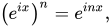
since Euler’s formula implies that the left side is equal to (cos x + sin x)n while the right side is equal to 

Why
Thanks to Abraham de Moivre we have this useful formula:
[ r(cos θ + i sin θ) ]n = rn(cos nθ + i sin nθ)
But what does it do?
The formula allows us multiply a complex number by itself (as many times as we want) in one go! [3]
De Moivre’s Theorem is an essential theorem when working with complex numbers. This theorem can help us easily find the powers and roots of complex numbers in polar form. [4]
See Theoretical Knowledge Vs Practical Application.
How
Let’s use a simple example to see how to use De Moivre’s Theorem.

What are the 3^rd roots of the complex number z = 1-i√3?
Many of the References and Additional Reading websites and Videos will assist you with understanding and applying De Moivre’s Theorem.
As some professors say: “It is intuitively obvious to even the most casual observer.“
Notes
cis is a mathematical notation defined by cis x = cos x + i sin x, where cos is the cosine function, i is the imaginary unit and sin is the sine function. The notation is less commonly used in mathematics than Euler’s formula, eix, which offers an even shorter notation for cos x + i sin x, but cis(x) is widely used as a name for this function in software libraries. [5]
Euler’s formula, named after Leonhard Euler, is a mathematical formula in complex analysis that establishes the fundamental relationship between the trigonometric functions and the complex exponential function. Euler’s formula states that for any real number x:
where e is the base of the natural logarithm, i is the imaginary unit, and cos and sin are the trigonometric functions cosine and sine respectively. This complex exponential function is sometimes denoted cis x (“cosine plus i sine”). The formula is still valid if x is a complex number, and so some authors refer to the more general complex version as Euler’s formula.[1]
Euler’s formula is ubiquitous in mathematics, physics, chemistry, and engineering. The physicist Richard Feynman called the equation “our jewel” and “the most remarkable formula in mathematics”.[2]
When x = π, Euler’s formula may be rewritten as eiπ + 1 = 0 or eiπ = -1, which is known as Euler’s identity. [6]
References
[1] ⭐ “De Moivre’s Formula”. 2023. CUEMATH. https://www.cuemath.com/de-moivre-formula/.
[2] ⭐ “How to use De Moivre’s theorem to simplify (1 – I)10? – GeeksForGeeks”. 2021. GeeksForGeeks. https://www.geeksforgeeks.org/how-to-use-de-moivres-theorem-to-simplify-1-i10/.
[3] “De Moivre’s Formula”. 2023. mathsisfun.com. https://www.mathsisfun.com/algebra/de-moivres-formula.html.
[4] “De Moivre’s Theorem – Formulas, Explanation, and Examples”. 2023. storyofmathematics.com. https://www.storyofmathematics.com/de-moivres-theorem/.
[5] “cis (Mathematics) – Wikipedia”. 2023. en.wikipedia.org. https://en.wikipedia.org/wiki/Cis_(mathematics).
[6] “Euler’s Formula – Wikipedia”. 2023. en.wikipedia.org. https://en.wikipedia.org/wiki/Euler%27s_formula.
[7] “De Moivre’s Theorem”. 2023. artofproblemsolving.com. https://artofproblemsolving.com/wiki/index.php/De_Moivre%27s_Theorem.
[8] “De Moivre’s Formula – Wikipedia”. 2023. en.wikipedia.org. https://en.wikipedia.org/wiki/De_Moivre%27s_formula.
Additional Reading
“5.3: DeMoivre’s Theorem and Powers of Complex Numbers”. 2017. Mathematics LibreTexts. https://math.libretexts.org/Bookshelves/Precalculus/Book%3A_Trigonometry_(Sundstrom_and_Schlicker)/05%3A_Complex_Numbers_and_Polar_Coordinates/5.03%3A_DeMoivres_Theorem_and_Powers_of_Complex_Numbers.
“8.5: Polar Form Of Complex Numbers”. 2015. Mathematics LibreTexts. https://math.libretexts.org/Bookshelves/Precalculus/Precalculus_1e_(OpenStax)/08%3A_Further_Applications_of_Trigonometry/8.05%3A_Polar_Form_of_Complex_Numbers.
“11.7: Polar Form Of Complex Numbers”. 2022. Mathematics LibreTexts. https://math.libretexts.org/Courses/Cosumnes_River_College/Math_370%3A_Precalculus/11%3A_Applications_of_Trigonometry/11.07%3A_Polar_Form_of_Complex_Numbers.
Bahram, BiBi. “What Is De Moivre’s Theorem?” Accessed February 12, 2026. https://qr.ae/pCzw76.
 Date, Sachin. “Abraham De Moivre, His Famous Theorem, and the Birth of the Normal Curve.” TDS Archive, February 14, 2024. https://medium.com/data-science/abraham-de-moivre-his-famous-theorem-and-the-birth-of-the-normal-curve-ee11ab5f9f20.
It was around 1689 that one of biggest discoveries in probability unfolded in the Swiss Confederation. The protagonist was Jacob Bernoulli and the discovery was the Weak Law of Large Numbers. Bernoulli showed that the mean of a randomly selected sample converges in probability to the mean of the population. Unfortunately, Bernoulli proved the WLLN in the context of a Binomial experiment and in the 1600s, there was not one soul in Europe who knew how to efficiently approximate, leave alone calculate, the big, bulky factorials that constitute binomial probabilities. And that meant that for all its ground-breaking importance, the Weak Law of Large Numbers enjoyed little practical utility.
It would be another four decades after Jacob Bernoulli’s death in 1705, that a self-exiled Frenchman in England by the name Abraham De Moivre would crack the problem of binomial approximation, and in doing so gift us the normal distribution curve.
This is the story of De Moivre, his theorem, and his legacy.
“Demoivres Theorem Calculator”. 2023. Math Celebrity. https://www.mathcelebrity.com/demoivre.php.
“De Moivre’s Theorem | Brilliant Math & Science Wiki”. 2023. brilliant.org. https://brilliant.org/wiki/de-moivres-theorem/.
Lloyd, Philip. “How Does De Moivre’s Theorem Work?” Accessed February 12, 2026. https://qr.ae/pCzwXI.
McBride, Martin. “De Moivre’s Theorem.” Technological Singularity, April 22, 2024. https://medium.com/technological-singularity/de-moivres-theorem-9e9cb9a5703b.
McNulty, Keith. “The Beautiful Simplicity of DeMoivre’s Theorem.” Medium, January 1, 2026. https://blog.keithmcnulty.org/the-beautiful-simplicity-of-demoivres-theorem-51a575a5ba09.
DeMoivre’s Theorem is a simple theorem relating complex numbers to trigonometry. It was proposed and proved for all positive integers n by Abraham DeMoivre (1667–1754), a French mathematician who was a religious exile in England from a young age and a friend of such greats as Isaac Newton and Edmond Halley.
“Polar Form Of A Complex Number”. 2023. varsitytutors.com. https://www.varsitytutors.com/hotmath/hotmath_help/topics/polar-form-of-a-complex-number.
Smith, Archie. “Why We All Should Learn About Complex Numbers.” Cantor’s Paradise, May 29, 2024. https://www.cantorsparadise.com/why-we-all-should-learn-about-complex-numbers-3dc066b017c8.
Most of the readers interested in mathematics will be aware of complex numbers. This seemingly new world of numbers has been the cause of many discoveries in math. When I first learnt about complex numbers, I questioned the applications of this new system of numbers. After having studied and gained an understanding of complex numbers I can appreciate just how important they are to math. So in this article, I would like to scratch the surface of what complex numbers can allow us to do. We will also look at solving a Cambridge math admissions problem, which hopefully you will see becomes very accessible once we understand the power of complex numbers. I will quickly introduce some key concepts we should be aware of before we tackle the question together.
Videos
This precalculus video tutorial focuses on complex numbers in polar form and de moivre’s theorem. The full version of this video explains how to find the products, quotients, powers and nth roots of complex numbers in polar form as well as converting it to and from rectangular form. This video contains plenty of examples and practice problems and is useful for high school and college students taking precalculus or trigonometry.
How to write a complex number in polar form and then use DeMoirve’s theorem to raise that complex number to a power and then write in rectangular form again.
Medium Member Only
⭐ I suggest that you read the entire reference. Other references can be read in their entirety but I leave that up to you.
The featured image on this page is from the CUEMATH website.
 Mathematical Mysteries