
“Lions and tigers, and bears, oh my!” ~ Dorothy in Wizard of Oz
Or should we say axioms, corollaries, lemmas, postulates, conjectures and theorems, oh my!
Axiom
There are certain elementary statements, which are self evident and which are accepted without any questions. These are called axioms.
Axiom 1: Things which are equal to the same thing are equal to one another.
For example:
Draw a line segment AB of length 10cm. Draw a second line CD having length equal to that of AB, using a compass. Measure the length of CD. We see that, CD = 10cm.
We can write it as, CD = AB and AB = 10cm implies CD = 10cm.
Arif, View. 2016. “Axioms, Postulates And Theorems – Class VIII”. Breath Math. https://breathmath.com/2016/02/18/axioms-postulates-and-theorems-class-viii/.
A statement that is taken to be true, so that further reasoning can be done.
It is not something we want to prove.
Example: one of Euclid’s axioms (over 2300 years ago!) is:
“If A and B are two numbers that are the same, and C and D are also the same, A+C is the same as B+D”
“Definition Of Axiom”. 2021. mathsisfun.Com. https://www.mathsisfun.com/definitions/axiom.html.
In mathematics an axiom is something which is the starting point for the logical deduction of other theorems. They cannot be proven with a logic derivation unless they are redundant. That means every field in mathematics can be boiled down to a set of axioms. One of the axioms of arithmetic is that a + b = b + a. You can’t prove that, but it is the basis of arithmetic and something we use rather often.
“Theorems, Lemmas And Other Definitions | Mathblog”. 2011. mathblog.dk. https://www.mathblog.dk/theorems-lemmas/.
In math it is known that you can’t prove everything. So, in order to lay a ground work for proving things, there is a list of things we “take for granted as true”. These things are either very basic definitions such as “point” “line”, or facts assumed to be true without proof that are very very simple. Then with these an accepted rules, one can prove other statements are true. The assumed facts are called “axioms” or sometimes “postulates”. The most famous are five postulates/axioms that Euclid’s geometry takes for granted. There are the following:
- A straight line segment can be drawn joining any two points.
- Any straight line segment can be extended indefinitely in a straight line.
- Given any straight line segment, a circle can be drawn having the segment as radius and one endpoint as center.
- All right angles are congruent.
- If two lines are drawn which intersect a third in such a way that the sum of the inner angles on one side is less than two right angles, then the two lines inevitably must intersect each other on that side if extended far enough. This postulate is equivalent to what is known as the parallel postulate.
The fifth postulate is perhaps the most “famous” as it is complex and people wanted to prove it from the first four, but couldn’t, and then it was discovered that there were systems in which the first four were true but the fifth wasn’t. These are called “non-Euclidean” geometries. Of course, here we take for granted what a point, line segment, line, circle, angle, and radius are at least as well.
Farris, Steven. “I don’t understand the concept of an axiom in mathematics. What is an axiom? How would you introduce or explain this concept to a 10-year-old?”. 2023. Quora. https://qr.ae/pyVTM1.
An axiom is just any concept or statement that we take as being true, without any need for a formal proof. It is usually something very fundamental to a given field, very well-established and/or self-evident. A non-mathematical example might be a simple statement of an observed truth, such as “the Sun rises in the East.” In math, such things as “a line can be extended to infinity” or “a point has no size” might be good examples. An axiom differs from a postulate in that an axiom is typically more general and common, while a postulate may apply only to a specific field. For instance, the difference between Euclidean and non-Euclidean geometries are just changes to one or more of the postulates on which they’re based. Another way to look at this is that a postulate is something we assume to be true only within that specific field.
Myers, Bob. “I don’t understand the concept of an axiom in mathematics. What is an axiom? How would you introduce or explain this concept to a 10-year-old?”. 2023. Quora. https://qr.ae/pyVTwW.
It’s not so much that they don’t require proof, it’s that they can’t be proven. Axioms are starting assumptions.
Everything that is proven is based on axioms, theorems, or definitions. You can’t prove an axiom without already having something to base your proof on, because deductive reasoning always needs a starting place. You have to start with good assumptions, and hope they’re true, or at least useful in the type of math you wish to create. (Don’t forget that math is just a human construct!)
That doesn’t mean that axioms come out of thin air. Some axioms are developed because if they don’t exist, the math doesn’t model the way we want it to. If you put 3 apples in your grocery cart, then put 4 more in, you have 7. But it works the same if you put 3 in, then 4. Now you have the commutative property of addition. You can’t prove addition works this way, but you need to set it up so that it does.
Often axioms are demonstrable. Try to draw two non-congruent triangles with sides of length 3, 4, and 5 units. You can’t. But you haven’t proved it using deductive reasoning. You’ve made a conjecture using inductive reasoning.
McClung, Carter. “Why don’t axioms require proofs?”. 2023. Quora. https://qr.ae/pyVTO4.
The axioms or postulates are the assumptions that are obvious universal truths, they are not proved. Euclid has introduced the geometry fundamentals like geometric shapes and figures in his book elements and has stated 5 main axioms or postulates. Here, we are going to discuss the definition of euclidean geometry, its elements, axioms and five important postulates. [4]
Corollary
A theorem that follows on from another theorem.
Example: there is a Theorem that says: two angles that together form a straight line are “supplementary” (they add to 180°).
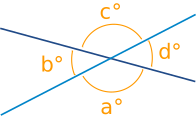
A Corollary to this is the “Vertical Angle Theorem” that says: where two lines intersect, the angles opposite each other are equal (a=c and b=d in the diagram).
Proof that a=c:
Angles a and b are on a straight line, so:
⇒ angles a + b = 180° and so a = 180° − b
Angles c and b are also on a straight line, so:
⇒ angles c + b = 180° and so c = 180° − b
So angle a = angle c
“Corollary Definition (Illustrated Mathematics Dictionary)”. 2021. mathsisfun.com. https://www.mathsisfun.com/definitions/corollary.html.
A corollary of a theorem or a definition is a statement that can be deduced directly from that theorem or statement. It still needs to be proved, though.
A simple example: Theorem: The sum of the angles of a triangle is pi radians.
Corollary: No angle in a right angled triangle can be obtuse.
Or: Definition: A prime number is one that can be divided without remainder only by 1 and itself.
Corollary: No even number > 2 can be prime.
A corollary is a theorem that can be proved from another theorem. For example: If two angles of a triangle are equal, then the sides opposite them are equal . A corollary would be: If a triangle is equilateral, it is also equiangular.
“What Are The Examples Of Corollary In Math? – Quora”. 2021. quora.com. https://www.quora.com/What-are-the-examples-of-corollary-in-math.
Lemmas and corollaries are theorems themselves. It’s really not necessary to have different names for them. A corollary is a theorem that “easily” follows from the preceding theorem. For example, after proving the theorem that the sum of the angles in a triangle is 180°, an easy theorem to prove is that the sum of the angles in a quadrilateral is 360°. The proof is just to cut the quadrilateral into two triangles. So that theorem could be called a corollary. [2]
Lemma
There is not formal difference between a theorem and a lemma. A lemma is a proven proposition just like a theorem. Usually a lemma is used as a stepping stone for proving something larger. That means the convention is to call the main statement for a theorem and then split the problem into several smaller problems which are stated as lemmas. Wolfram suggest that a lemma is a short theorem used to prove something larger.
Breaking part of the main proof out into lemmas is a good way to create a structure in a proof and sometimes their importance will prove more valuable than the main theorem.
“Theorems, Lemmas And Other Definitions | Mathblog”. 2011. mathblog.dk. https://www.mathblog.dk/theorems-lemmas/.
Like a Theorem, but not as important. It is a minor result that has been proved to be true (using facts that were already known). [3]
Lemmas and corollaries are theorems themselves. It’s really not necessary to have different names for them. A lemma is a theorem that’s mentioned primarily because it’s used in one or more following theorems, but it’s not so interesting in itself. Sometimes lemmas are just minor observations, but sometimes they’ve got detailed proofs. [2]
Postulate
Postulates in geometry are very similar to axioms, self-evident truths, and beliefs in logic, political philosophy and personal decision-making.
Geometry postulates, or axioms, are accepted statements or facts. Thus, there is no need to prove them.
For example:
Postulate 1.1, Through two points, there is exactly 1 line. Line t is the only line passing through E and F.

In geometry, “Axiom” and “Postulate” are essentially interchangeable. In antiquity, they referred to propositions that were “obviously true” and only had to be stated, and not proven. In modern mathematics there is no longer an assumption that axioms are “obviously true”. Axioms are merely ‘background’ assumptions we make. The best analogy I know is that axioms are the “rules of the game”. In Euclid’s Geometry, the main axioms/postulates are:
- Given any two distinct points, there is a line that contains them.
- Any line segment can be extended to an infinite line.
- Given a point and a radius, there is a circle with center in that point and that radius.
- All right angles are equal to one another.
- If a straight line falling on two straight lines makes the interior angles on the same side less than two right angles, the two straight lines, if produced indefinitely, meet on that side on which are the angles less than the two right angles. (The parallel postulate).
A theorem is a logical consequence of the axioms. In Geometry, the “propositions” are all theorems: they are derived using the axioms and the valid rules. A “Corollary” is a theorem that is usually considered an “easy consequence” of another theorem. What is or is not a corollary is entirely subjective. Sometimes what an author thinks is a ‘corollary’ is deemed more important than the corresponding theorem. (The same goes for “Lemma“s, which are theorems that are considered auxiliary to proving some other, more important in the view of the author, theorem).
A “hypothesis” is an assumption made. For example, “If xx is an even integer, then x2x2 is an even integer” I am not asserting that x2x2 is even or odd; I am asserting that if something happens (namely, if xx happens to be an even integer) then something else will also happen. Here, “xx is an even integer” is the hypothesis being made to prove it.
Gordon Gustafson, and Arturo Magidin. 2010. “Difference Between Axioms, Theorems, Postulates, Corollaries, And Hypotheses”. Mathematics Stack Exchange. https://math.stackexchange.com/questions/7717/difference-between-axioms-theorems-postulates-corollaries-and-hypotheses.
In geometry, a postulate is a statement that is assumed to be true based on basic geometric principles. An example of a postulate is the statement “exactly one line may be drawn through any two points.” A long time ago, postulates were the ideas that were thought to be so obviously true they did not require a proof. [1]
An axiom is a statement, usually considered to be self-evident, that assumed to be true without proof. It is used as a starting point in mathematical proof for deducing other truths.
Classically, axioms were considered different from postulates. An axiom would refer to a self-evident assumption common to many areas of inquiry, while a postulate referred to a hypothesis specific to a certain line of inquiry, that was accepted without proof. As an example, in Euclid’s Elements, you can compare “common notions” (axioms) with postulates.
In much of modern mathematics, however, there is generally no difference between what were classically referred to as “axioms” and “postulates”. Modern mathematics distinguishes between logical axioms and non-logical axioms, with the latter sometimes being referred to as postulates.
Postulates are assumptions which are specific to geometry but axioms are assumptions are used thru’ out mathematics and not specific to geometry.
“What is the difference between an axiom and postulates”. 2023. BYJUs. https://byjus.com/question-answer/what-is-the-difference-between-an-axiom-and-postulates/.
Hint: First you need to define both the terms, axiom and postulates. Examples of both can be stated. The main difference is between their application in specific fields in mathematics.
An axiom is a statement or proposition which is regarded as being established, accepted, or self-evidently true on which an abstractly defined structure is based.
More precisely an axiom is a statement that is self-evident without any proof which is a starting point for further reasoning and arguments.
Postulate verbally means a fact, or truth of (something) as a basis for reasoning, discussion, or belief.
Postulates are the basic structure from which lemmas and theorems are derived.
Nowadays ‘axiom’ and ‘postulate’ are usually interchangeable terms. One key difference between them is that postulates are true assumptions that are specific to geometry. Axioms are true assumptions used throughout mathematics and not specifically linked to geometry.
“What is the difference between an axiom and a postulate?”. 2023. Vedantu. https://www.vedantu.com/question-answer/difference-between-an-axiom-and-a-post-class-10-maths-cbse-5efeafa98c08f1791a1cc34a.
Conjecture
A conjecture is a mathematical statement that has not yet been rigorously proved. Conjectures arise when one notices a pattern that holds true for many cases. However, just because a pattern holds true for many cases does not mean that the pattern will hold true for all cases. Conjectures must be proved for the mathematical observation to be fully accepted. When a conjecture is rigorously proved, it becomes a theorem.
“Conjectures | Brilliant Math & Science Wiki”. 2022. brilliant.org. https://brilliant.org/wiki/conjectures/.
“The Subtle Art Of The Mathematical Conjecture | Quanta Magazine”. 2019. Quanta Magazine. https://www.quantamagazine.org/the-subtle-art-of-the-mathematical-conjecture-20190507/.
Theorem
A result that has been proved to be true (using operations and facts that were already known).
Example: The “Pythagoras Theorem” proved that a2 + b2 = c2 for a right angled triangle.
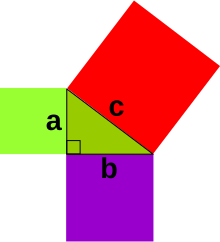
A Theorem is a major result, a minor result is called a Lemma.
“Theorem Definition (Illustrated Mathematics Dictionary)”. 2021. mathsisfun.Com. https://www.mathsisfun.com/definitions/theorem.html.
“Theorems, Corollaries, Lemmas”. 2021. mathsisfun.com. https://www.mathsisfun.com/algebra/theorems-lemmas.html.
A statement that is proven true using postulates, definitions, and previously proven theorems.
A theorem is a mathematical statement that can and must be proven to be true. You may have been first exposed to the term when learning about the Pythagorean Theorem. Learning different theorems and proving they are true is an important part of Geometry. [1]
References
[1] “4.1 Theorems and Proofs”. 2022. CK-12 Foundation. https://flexbooks.ck12.org/cbook/ck-12-interactive-geometry-for-ccss/section/4.1/primary/lesson/theorems-and-proofs-geo-ccss/.
[2] Joyce, David. “Can a theorem be proved by a corollary?”. 2023. Quora. https://qr.ae/pybAMq.
Yes, a theorem can be proved by a corollary just so long as the corollary is proved first.
You might have a sequence of theorems in logical order like this: Theorem 1, Corollary 2, Lemma 3, Theorem 4, Theorem 5. Each one is proved from those that precede it, but Theorem 5 could depend only on Corollary 2 and Lemma 3.
Sometimes theorems are presented in a different order than the logical order, and sometimes even in reverse logical order, but whatever order they’re presented, it is necessary that there is no circular logic.
[3] “Definition Of Lemma”. 2021. mathsisfun.com. https://www.mathsisfun.com/definitions/lemma.html.
[4] “Euclidean Geometry (Definition, Facts, Axioms and Postulates)”. 2021. BYJUS. BYJU’S. September 20. https://byjus.com/maths/euclidean-geometry/.
Additional Reading
“Basic Math Definitions”. 2021. mathsisfun.com. https://www.mathsisfun.com/basic-math-definitions.html.
Browning, Wes. “Can a theorem be proved by another theorem?”. 2023. Quora. https://qr.ae/pybAUz.
Sure. Sometimes the second theorem is called a “corollary.” Sometimes the first theorem is called a “lemma” and the second is called a theorem implied by the lemma. Or they’re both called theorems. The choice of names is up to the author of the exposition and is meant to clarify the logical flow.
You may occasionally also see the term “porism” used. After a theorem has been proved, a porism is another theorem that can be proved by essentially the same proof as the first, usually by obvious modifications. I had a professor in math grad school who loved to trot porisms out after proving a theorem in his classes.
“Byrne’s Euclid”. 2021. C82.Net. https://www.c82.net/euclid/.
THE FIRST SIX BOOKS OF
THE ELEMENTS OF EUCLID
WITH COLOURED DIAGRAMS AND SYMBOLS
A reproduction of Oliver Byrne’s celebrated work from 1847 plus interactive diagrams, cross references, and posters designed by Nicholas Rougeux
“Definitions. Postulates. Axioms: First Principles Of Plane Geometry “. 2021. themathpage.com. https://themathpage.com/aBookI/first.htm#post.
“Geometry Postulates”. 2021. basic-mathematics.com. https://www.basic-mathematics.com/geometry-postulates.html.
Mystery, Mike the. 2024. “Is George Orwell Right About 2+2=4 in Maths?” Medium. Medium. March 12. https://medium.com/@Mike_Meng/is-george-orwell-right-about-2-2-4-in-maths-3bb0f6d5dd88.
Freedom is the freedom to say that two plus two makes four. ——George Orwell, Nineteen Eighty-Four.
When I first read George Orwell’s great “1984”, the above sentence left an indelible impact on me. It is worth mentioning that my first reaction to this quote was why Orwell used 2+2=4 instead of 1+1=2. And that’s exactly the first time I realized I was pedantic enough to get a maths degree in future.
Ok, so why 2+2=4 is true? Before directly into the topic, i need to introduce some basic rules that we use to calculate numbers every single day.
The rule is actually called Peano axioms, which is a logic system about natural numbers proposed by the 19th-century mathematician Giuseppe Peano. And we can establish an arithmetic system by these sets of axioms, which is also known as the Peano arithmetic system.
“Zermelo-Fraenkel Set Theory (ZFC)”. 2023. Mathematical Mysteries. https://mathematicalmysteries.org/zermelo-fraenkel-set-theory-zfc/.
Zermelo–Fraenkel set theory (abbreviated ZF) is a system of axioms used to describe set theory. When the axiom of choice is added to ZF, the system is called ZFC. It is the system of axioms used in set theory by most mathematicians today.
The featured image on this page is from the Redubble website.