Algebra (from Arabic: الجبر, romanized: al-jabr, lit. ’reunion of broken parts, bonesetting’) is one of the broad areas of mathematics, together with number theory, geometry and analysis. In its most general form, algebra is the study of mathematical symbols and the rules for manipulating these symbols; it is a unifying thread of almost all of mathematics. It includes everything from elementary equation solving to the study of abstractions such as groups, rings, and fields.
“Algebra – Wikipedia”. 2021. en.wikipedia.org. https://en.wikipedia.org/wiki/Algebra.
Algebra is a branch of mathematics that deals with symbols, variables, and the rules for manipulating them to solve equations and study relationships between quantities. It is a fundamental part of mathematics and serves as a bridge between arithmetic (basic operations with numbers) and more advanced mathematical concepts.
In algebra, you work with expressions and equations involving variables (usually represented by letters like x, y, or a) to solve for unknown values. Key concepts and techniques in algebra include:
- Variables: These are symbols (usually letters) that represent unknown or changing quantities. For example, in the equation 2x+3=7, x is a variable.
- Expressions: These are combinations of numbers, variables, and mathematical operations like addition, subtraction, multiplication, and division. For example, 2x+3 is an algebraic expression.
- Equations: These are statements that show two expressions are equal. Solving equations involves finding the values of variables that make the equation true. For example, solving the equation 2x+3=7 involves finding the value of x that makes the equation true.
- Polynomials: These are algebraic expressions with one or more terms, each consisting of a constant coefficient multiplied by a variable raised to a non-negative integer exponent. For example, 3x2−2x+1 is a polynomial.
- Linear Equations: These are equations in which the highest power of the variable is 1. For example, 2x+3=7 is a linear equation.
- Quadratic Equations: These are equations in which the highest power of the variable is 2. For example, x2−4=0 is a quadratic equation.
- Functions: Functions in algebra represent relationships between variables. They take an input (usually x) and produce an output (usually y). Functions are often represented using equations, such as y=2x+1.
- Inequalities: Inequalities involve comparing two expressions using symbols like <, >, ≤, or ≥. Solving inequalities is about finding the sets of values for which the inequality is true.
- Factoring: Factoring involves breaking down algebraic expressions or equations into simpler components, often to solve equations or simplify expressions.
- Graphs: Graphs are often used to represent algebraic equations visually. For example, linear equations result in straight-line graphs, while quadratic equations result in parabolic curves.
Algebra plays a crucial role in various fields of science, engineering, economics, and many other areas, as it provides tools for modeling, problem-solving, and analyzing relationships between quantities. It is considered one of the foundational subjects in mathematics and is typically introduced in middle or high school, with more advanced topics studied in college-level courses.
Clark, Olivia. “What Is an Algebra?” 2023. Quora. https://qr.ae/pKRqfp.
Suggested Reading
“Algebra – What Is Algebra? Basics, Definition, Examples”. 2021. CUEMATH. https://www.cuemath.com/algebra/.
“Where The Word “Algebra” Came From?”. 2021. Medium. https://mathladyhazel.medium.com/where-the-word-algebra-came-from-6244041f83c3.
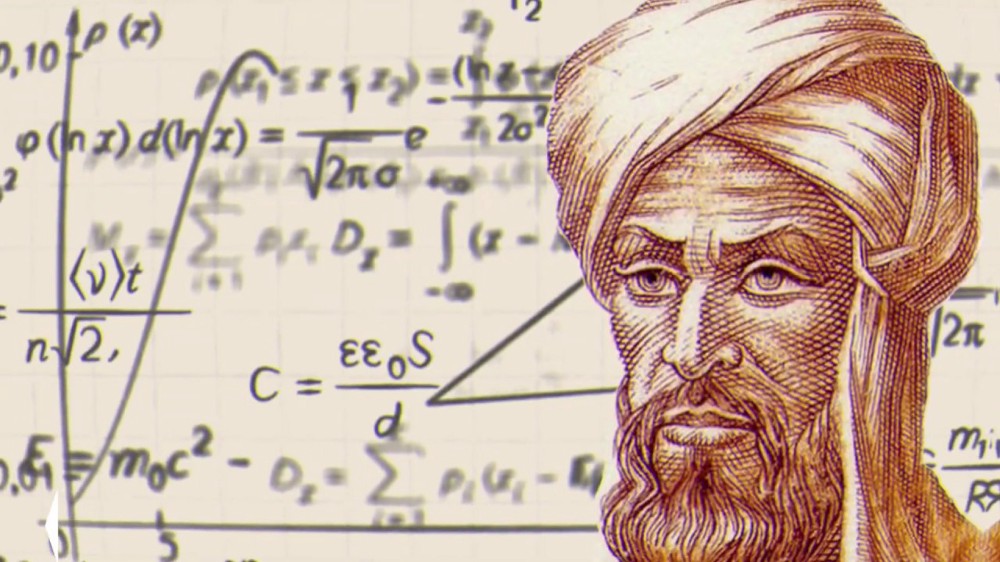
The featured image on this page is Abū Ja’far Muḥammad ibn Mūsā al-Khwārizmī from the Medium website.
 Mathematical Mysteries