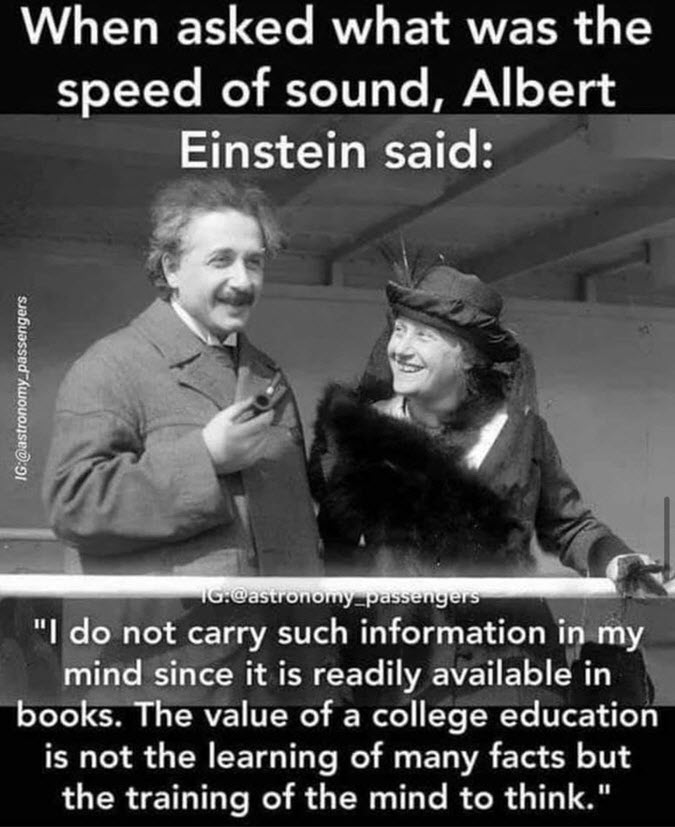
Understanding will often lead to memorization, but memorization alone often does not lead to understanding.
Understanding is much more important than memorization. Of course, memorization is also an integral component when it comes to learning things in academics. But students tend to rely more upon memorization when it comes to learning rather than trying to understand things conceptually. When you understand a concept, you will remember it for years whereas when you memorize the same, you will remember it for merely for days and gradually forget it. Conceptual understanding helps you understand the information on a deeper level unlike memorizing which merely touches the surface. Feynman believed that names do not constitute knowledge and that when you have memorized the name of something doesn’t mean you know stuffs about it. Knowing the name of something doesn’t mean you understand it. We talk in fact-deficient, obfuscating generalities to cover up our lack of understanding. He once said in an interview,
See that bird? It’s a brown-throated thrush, but in Germany it’s called a halzenfugel, and in Chinese they call it a chung ling, and even if you know all those names for it, you still know nothing about the bird. You only know something about people: what they call the bird. Now that thrush sings, and teaches its young to fly, and flies so many miles away during the summer across the country, and nobody knows how it finds its way.
Richard Feynman
Richard Feynman on the differences of merely knowing how to reason mathematically and understanding how and why things are physically analyzed in the way they are.
“Feynman’s Invaluable Advices For Students”. 2021. Medium. https://medium.com/@PhysicsHistory/feynmans-invaluable-advices-for-students-3b3f42c87e16.
Is it necessary to memorize formulas and values for logs, exponents, trigonometry, etc.?
“Knowing mathematical formulas” is not the same as “understanding mathematics”.
There is a big difference between “knowing a thing” and “understanding it”.
People who are good at mathematics do not look at a problem and say to themselves “What formula do I use to solve this?”
People who are good at mathematics use logical techniques or methods to solve problems not formulas or rules.
Good teachers carefully go through the proper reasoning for some concept and yet a disappointingly large proportion of students simply wait until the “formula” appears then simply apply the formula without understanding where it came from, despite the teacher’s best intentions!
I believe students need to appreciate the logic in mathematics otherwise they are just blindly following rules.
Some people actually believe that mathematics is just a whole lot of rules and if you know the rules, you will be good at mathematics!
Mathematics is completely logical and if you follow the logic it is enjoyable, exciting and very satisfying!
When I teach junior classes, I don’t just say “What is the formula for the area of a triangle?
I give out rewards for people who can explain WHY it is base times height divided by 2!
“9.4 Triangle Area”. 2022. CK-12 Foundation. https://flexbooks.ck12.org/cbook/ck-12-interactive-middle-school-math-6-for-ccss/section/9.4/related/lesson/triangle-area-msm6/.
When I teach more senior classes I don’t just say “What does sine squared theta plus cos squared theta equal?”
I say “Who can explain WHY it equals 1?”
“How do you prove sin2x + cos2x = 1?” 2023. socratic.org. https://socratic.org/questions/58a20042b72cff17846a6feb.
Then we proceed to use it in some problem.
Actually, a favourite question of mine when teaching a new senior class is this: “What is 2 to the power zero?”
Everyone “knows” it is 1.
Then I say, “Who can explain WHY it is 1?”
Hardly anyone can!
Berry, Brett. “The “ Zero Power Rule” Explained”. 2019. Medium. https://medium.com/i-math/the-zero-power-rule-explained-449b4bd6934d.
It is then that I find out those people who just wait for the “rule” and carry on using it without understanding why!
They soon find out that in my classes they have to understand why things are what they are and not just remember rules and results!
If you are into this concept, please look at Philip’s special website, KNOWING IS NOT UNDERSTANDING.
Lloyd, Philip. “Is it necessary to memorize formulas and values for logs, exponents, trigonometry, etc.?” 2023. Quora. https://qr.ae/py7wHn.
How do I learn to understand math instead of just memorizing formulas?
- Ask why, not just how, and be relentless in seeking an answer that satisfies you. Do not move past any step in a textbook, video or lecture without completely understanding the previous steps. If a resource skips steps that you need to take to understand, work out the intermediate steps on your own. Focus on the process, not simply the product.
- Look at a concept from several different perspectives, or mathematical representations, such as verbal, numerical, graphical and algebraic.
- Solve the same problem using multiple strategies (like writing multiple drafts of a paper). Reflect over the various solutions and identify the most efficient solution.
- Analyse your errors and look for patterns of errors. Be attuned to them as you study and practise math.
- Use technology (computer algebra systems, calculators, graphing software, tables and spreadsheets) to decrease the cognitive load of new learning. If you are learning something new, say how to evaluate definite integrals, don’t (always) exhaust yourself on things that you have previously mastered; it’s acceptable to use a calculator sometimes to skip the numerical evaluation part (adding fractions, etc.). But that said, do a fair amount of working out by hand.
- Draw a picture. Represent things visually as often as possible.
- Derive the formulas that previously you may have memorised.
- My favourite: look for the evolution of a mathematical concept. We learn special cases of a concept first and generalise to more abstract cases as we mature mathematically. Brainstorm as many math concepts as you can, organise them in groups and order them in increasing sophistication. For example, under the heading of Rate of Change, consider this progression from division to derivative:
- division of whole numbers
- fractions, percentages, decimals; equivalent fractions
- rates, ratios, proportions
- similarity and constant scale factor
- unit rates and slope/gradient
- finite differences, slope and linear functions
- right triangles and trigonometry (since, cosine and tangent)
- average and instantaneous rate of change
- secant and tangent lines
- derivatives
You may order it differently and that is great! We make connections in our own way or see some things more easily than others. The key is to see a common thread throughout the concepts and train yourself to be on the lookout for new connections. Strengthening this habit is at the heart of understanding mathematics and not just memorising formulas.
Maths, Raelene. “How do I learn to understand math instead of just memorizing formulas?”. 2023. Quora. https://qr.ae/pyMcgl.
 Mathematical Mysteries